ZRST works with universities, research institutes and international programmes as their Zambian partner. We collect field data, run surveys, co-author research and turn findings into action with government and communities. Explore research partnerships, published findings and ongoing studies.
See our sponsor portfolios → · See our events →
Publications and research outputs · Other research collaborations
AfroSAFE
Safe System for radical improvement of road safety in low and middle income African countries
What ZRST delivered
ZRST collected field data in Zambia, organised training in Lusaka and co-authored peer-reviewed research and the school-zone evaluation.
What the evidence shows
Vehicle speeds fell at both Zambian schools in the before-and-after study. Only one site measured speeds below 30 km/h. The study did not establish a reduction in crashes.
Who can verify it
The Swedish National Road and Transport Research Institute (VTI), Report 1226A documents the school findings. The European Commission’s CORDIS record identifies the project and consortium.
Objectives
- Bring the Safe System approach into road safety work in Ghana, Tanzania and Zambia.
- Review road safety management, infrastructure, vehicles, road user behaviour and post-crash care, and recommend improvements.
- Run pilots and train local professionals, with particular attention to people walking and cycling.
Key findings
- School-zone works cut vehicle speeds at both Zambian schools studied, but only one school fell below the 30 km/h limit (VTI Report 1226A).
- Ghana, Tanzania and Zambia align less with Safe System principles than Norway, Sweden and the Netherlands; low institutional influence and lack of funding are the main reasons.
- Even the mature European countries leave some effective measures unused because of political choices, goal conflicts and values.
What the project does
AfroSAFE brings together partners from Sweden, Norway, Denmark and the Netherlands with partners in Ghana, Tanzania and Zambia, to bring the Safe System approach into road safety work in Africa. It covers road safety management, safe infrastructure, safe vehicles, road user behaviour and post-crash care, with particular attention to people walking and cycling.
ZRST collected much of the Zambian field data, organised training in Lusaka and co-authored the project’s research.
Published research with ZRST authors
- Increasing traffic safety at schools in Zambia: a before and after study. VTI Report 1226A, Swedish National Road and Transport Research Institute, 2025. Co-authored by Thomas Miyoba, Somela Sinkala, Susan Mawele and Daniel Mwamba of ZRST. The study measured vehicle speeds and surveyed children, parents and teachers before and after works at two Zambian schools. Speeds fell at both schools, but only one school reached the 30 km/h limit. Read the summary ↗
- Safe system implementation in three African and three European countries: preliminary results from a comparison of six countries. Transportation Research Procedia 89 (2025), 243 to 254, Elsevier. Daniel Mwamba and Thomas Miyoba are co-authors. Read the paper ↗
- Safe System maturity and Safe System readiness in three European and three African countries: a comparison of an emerging versus a mature context. Transportation Research Interdisciplinary Perspectives, Elsevier, 2026. Thomas Miyoba and Daniel Mwamba are co-authors. Read the paper ↗
Training and conferences in Zambia
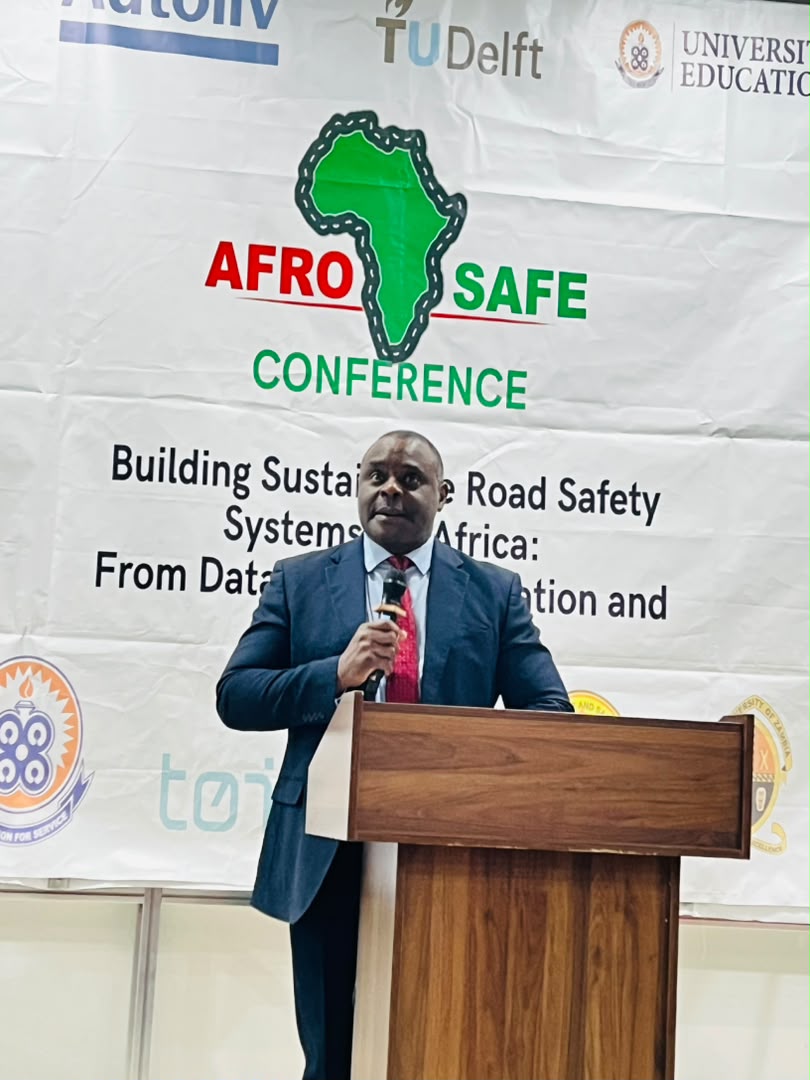
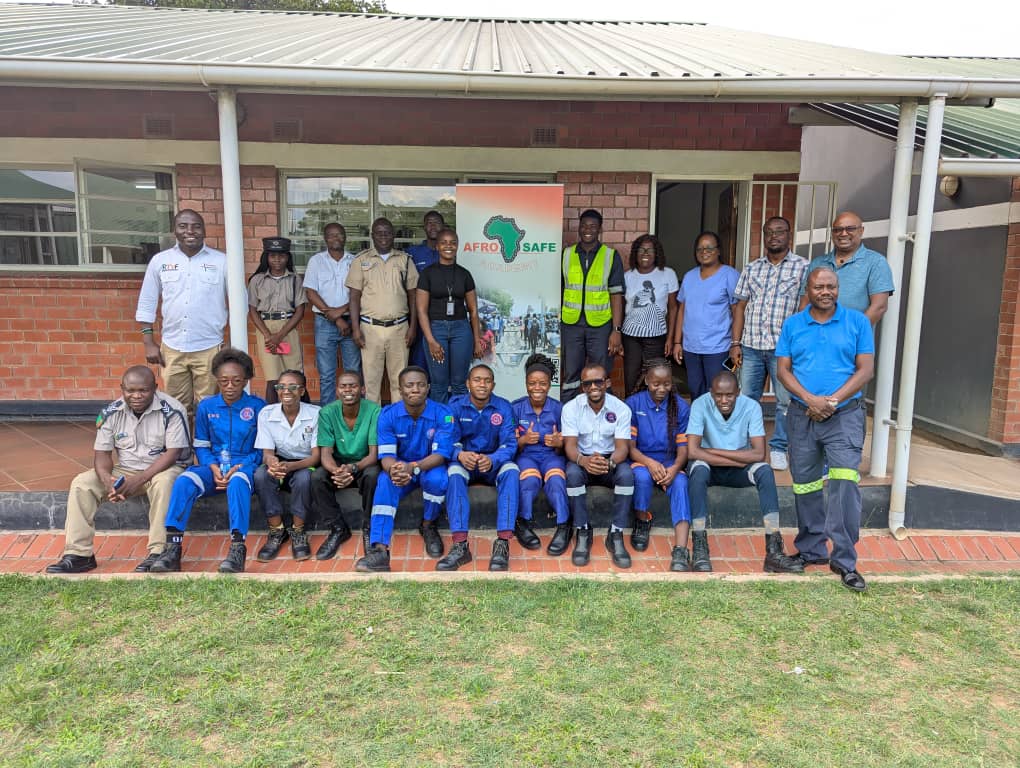
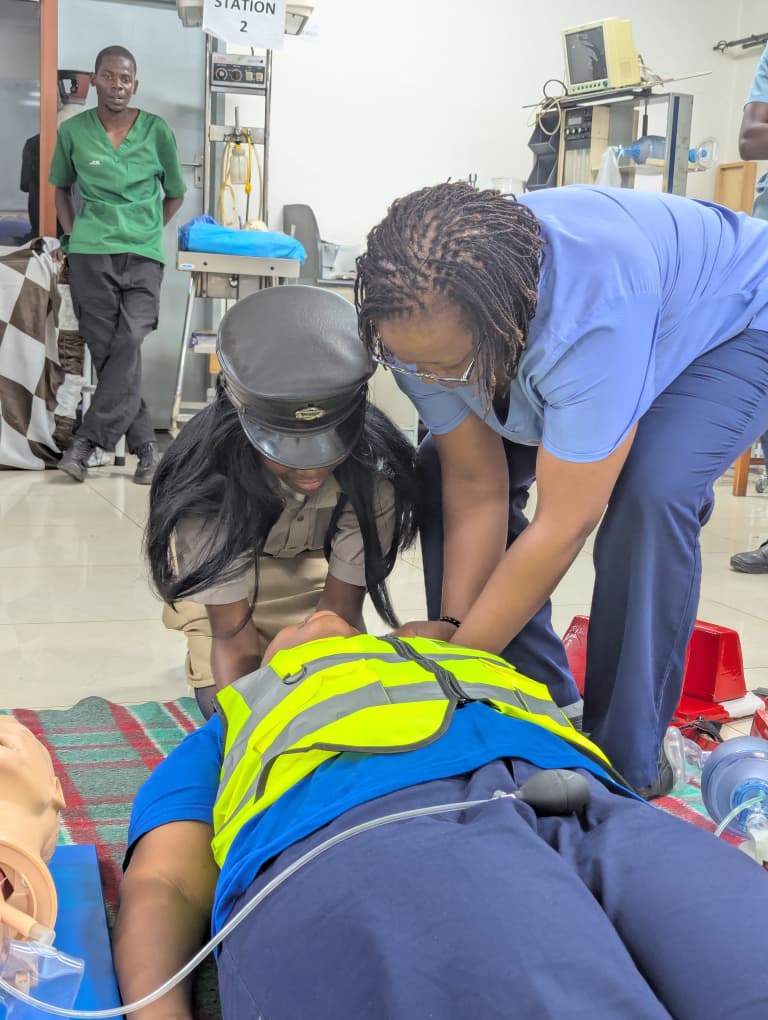
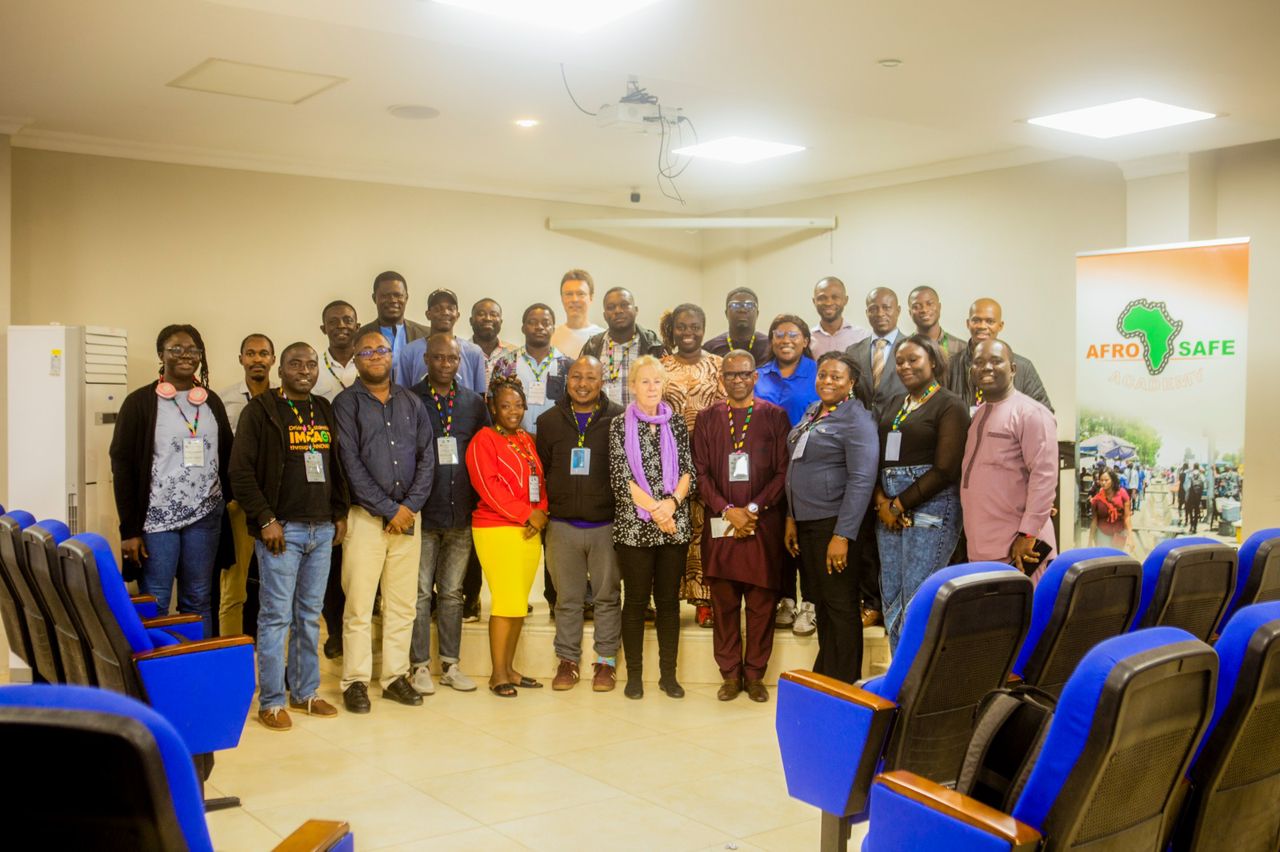
Under AfroSAFE, ZRST took part in the 2nd AfroSAFE Academy conference and traffic safety course in 2025, hosted a two day post-crash care training programme for emergency care providers at Levy Mwanawasa Medical University on 26 and 27 November 2025, and organised the 3rd AfroSAFE Academy international road safety conference at the University of Zambia School of Engineering on 10 and 11 June 2026.
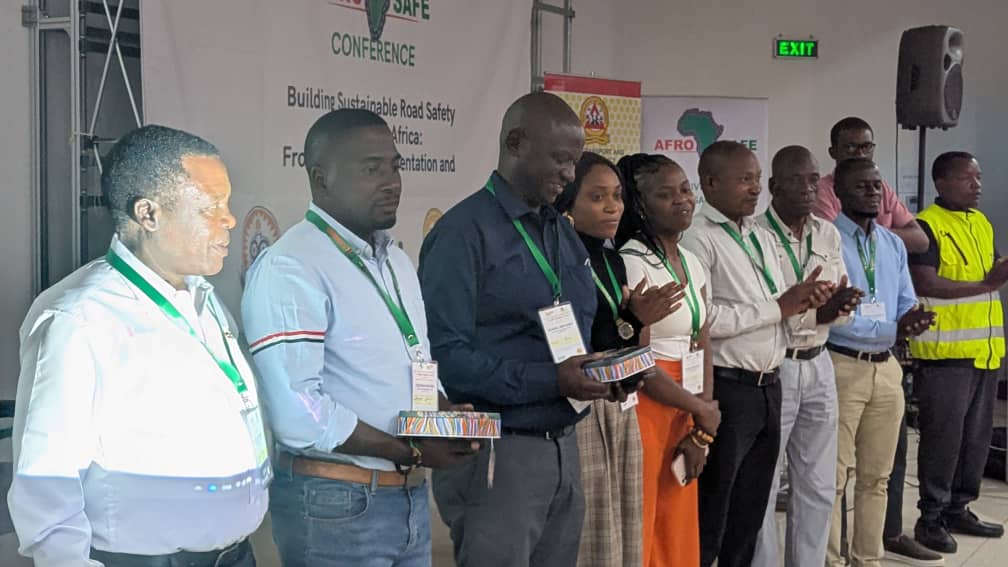
The ZRST team at the 3rd AfroSAFE Academy conference.
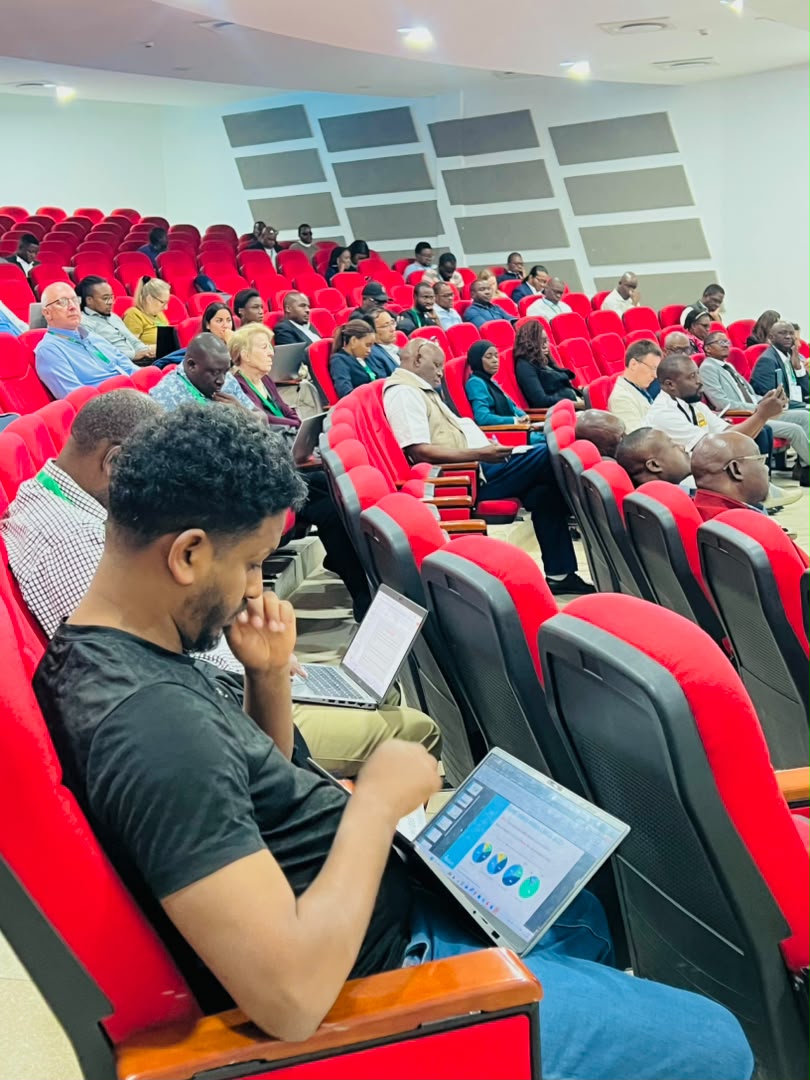
Post-crash care training for emergency care providers.
Participants at the post-crash care training.
ZRST at the conference and traffic safety course.
Conference coverage and photo source: ZRST · Read about the post-crash care training →
Independent sources
TRANS-SAFE
Transforming Road Safety in Africa
What ZRST delivered
ZRST led the Lusaka Walkability App fieldwork with Walk21. The team interviewed 1,137 pedestrians across ten study areas and mapped where people reported difficulty walking.
What the evidence shows
About two-thirds of recorded walking experiences raised concerns or were negative. Pedestrian crossings were the most frequently mentioned factor. The study measured walking experiences and did not estimate changes in crash rates.
Who can verify it
TRANS-SAFE and Walk21’s Lusaka case study documents the method and findings. The European Commission’s CORDIS record identifies the project and consortium.
Objectives
- Test Safe System solutions through city and national demonstrations in Lusaka, Cape Town, Kigali and Kumasi.
- Build a toolbox, training and policy support so the solutions can be repeated elsewhere.
- Deliver on the road safety recommendations of the African-EU Transport Task Force.
Key findings
- Lusaka walkability study, December 2023: 1,137 people interviewed, sharing 1,401 walking experiences across ten areas of the city.
- Two in three experiences were concerns or negative. The main problems were unsafe crossings, poor drainage, traffic speed, driver behaviour and fear of crime.
- Great East, Chilimbulu and Tokyo roads walked best; Katima Mulilo, Lumumba, Great North and Cairo roads and the railway station walked worst.
What the project does
TRANS-SAFE brings road safety agencies and experts from Europe and Africa together to test Safe System solutions in African cities and countries, and to build a toolbox, training and policy support around them.
ZRST peer reviewed the project’s report on its African peer learning network (Deliverable 2.2, 2023), which brought road safety professionals from across the continent together around the five pillars of the Safe System. ZRST also led the local team for a walkability safety assessment of Lusaka road corridors with the Walk21 Foundation in 2024.
Lusaka walkability fieldwork
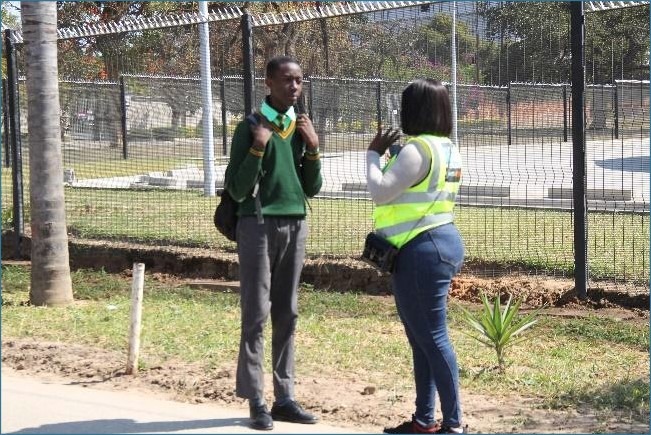
Photo source: TRANS-SAFE Walkability App toolbox. The photographs also appear in Figure 4 of the Lusaka Walkability Safety Assessment by ZRST and Walk21.
Independent sources
EMPOWER II
Tackling sexual harassment on public transport in sub-Saharan Africa
What ZRST delivered
ZRST served as Zambia’s National Contact Point, convened a SHE CAN workshop in Lusaka and surveyed about 1,200 passengers.
What the evidence shows
In the Lusaka sample, 822 respondents reported experiencing harassment and 1,185 reported witnessing it. These counts describe the survey sample.
Who can verify it
The High Volume Transport programme’s final report documents the Zambia work and names ZRST contributors.
Objectives
- Build the capacity of transport professionals to deliver gender-equitable, inclusive transport.
- Spread the use of the SHE CAN Tool for tackling sexual harassment on public transport.
Key findings
- Lusaka survey of about 1,200 passengers: 822 had experienced sexual harassment on public transport and 1,185 had witnessed it (sample counts, not national rates).
- Across the project, SHE CAN training reached 162 participants in seven National Contact Point countries.
- In the Kumasi survey, 95.1 percent of victims had not reported harassment, many because they did not know whom to report to.
What ZRST delivered
EMPOWER II trained transport professionals in sub-Saharan Africa to use the SHE CAN Tool, an online resource that helps decision makers and transport operators tackle sexual harassment on public transport. ZRST was the National Contact Point for Zambia, one of the in-country partners that carried the tool to transport authorities, ministries, operators and civil society.
In Lusaka, ZRST mapped stakeholders, ran a cross-sector SHE CAN workshop and carried out about 1,200 passenger surveys. In those surveys, 822 respondents said they had experienced sexual harassment on public transport and 1,185 said they had witnessed it. These are counts of respondents, not prevalence estimates. Thomas Miyoba and Daniel Mwamba of ZRST are named contributors to the project’s final report, and the findings led to ZRST’s May 2026 policy brief, Addressing Sexual Harassment in Public Transport in Zambia.
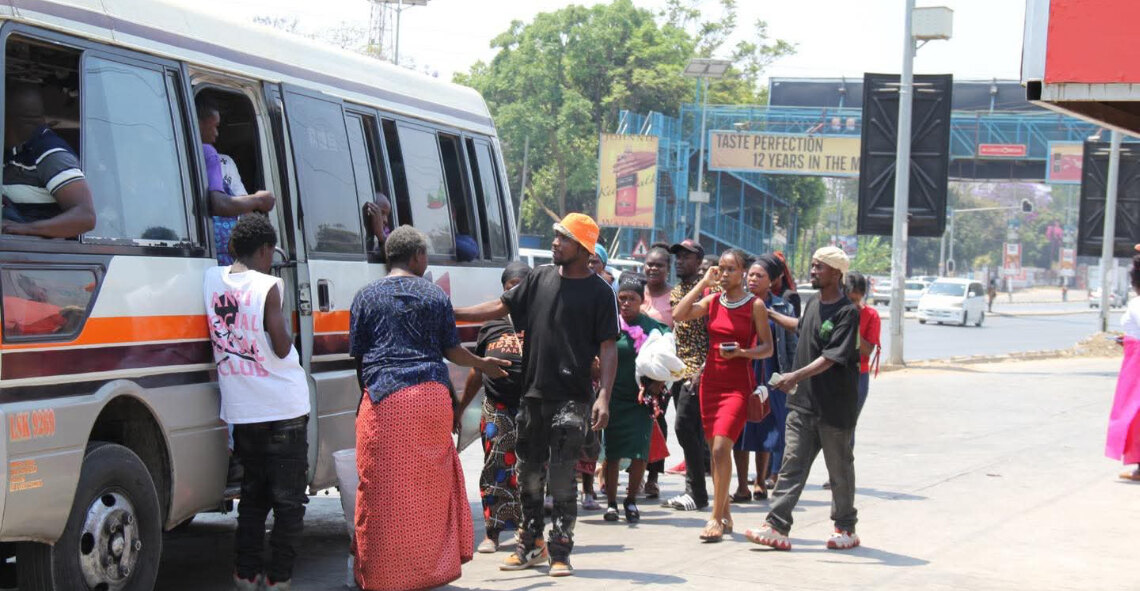
ZRST work with transport stakeholders on safer public transport.
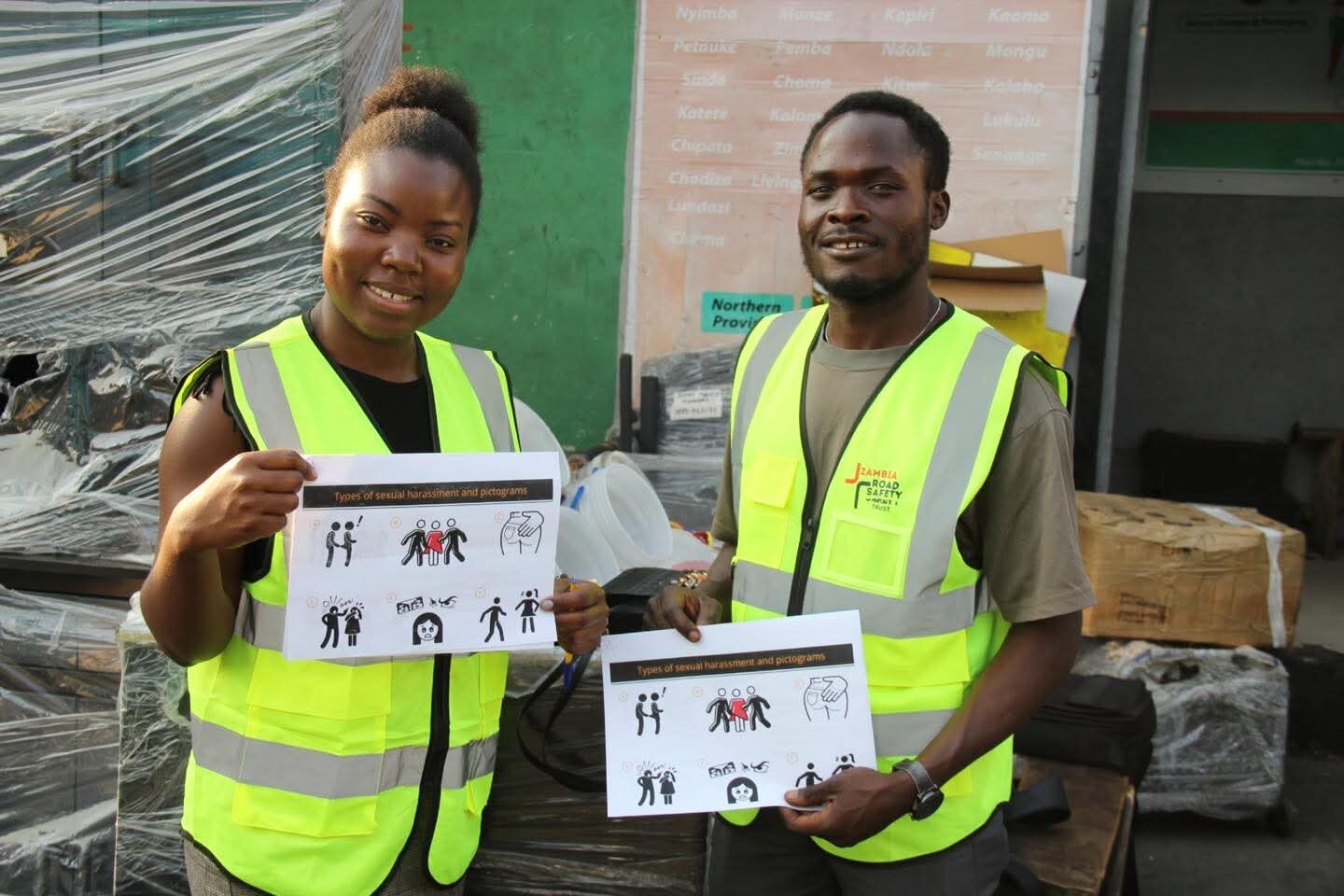
ZRST and partners during field engagement.
Independent sources
ZEMIA electric-bus analysis
Techno-socioeconomic analysis for an electric bus network in Zambia, with Lusaka as the case study
What ZRST delivered
ZRST helped conduct interviews and fieldwork, profiled six bus stops in Lusaka and Kitwe and co-authored the study.
What the evidence shows
The study modelled operating costs more than 50% lower than diesel equivalents. The estimate is for planning and depends on the study assumptions.
Who can verify it
The ZEMIA project record identifies the work package. Request the final report from ZRST to review the estimates and assumptions.
Objectives
- Test whether an electric bus network in Zambia makes economic, environmental and technical sense.
- Identify where to start, and what charging, finance and policy a roll-out would need.
Key findings
- Electric buses could cut operating costs by more than half compared with diesel.
- Converting about 40,000 minibuses could save 86 million litres of fuel a year, worth about ZMW 2.7 billion, and 178,509 tonnes of CO2 equivalent.
- Lusaka holds 55 percent of registered buses, so the study recommends starting there with slow chargers at bus stops. High upfront cost, fewer than 20 charging stations and a fragmented informal sector are the main barriers.
What the project does
Zambia’s buses run almost entirely on imported diesel and petrol, while most of its electricity comes from renewable sources. This study asked whether an electric bus network makes economic, environmental and practical sense, and where it should start. It combined interviews with operators, manufacturers, bus stop committees, regulators and power sector stakeholders with analysis of RTSA vehicle data, Lusaka City Council bus data, fuel and power costs, and route and hotspot mapping.
What ZRST delivered
ZRST co-led the research with ZEMIA and Greencrowd Partnership. Our team carried out the Zambian fieldwork and stakeholder engagement, including profiles of six key bus stops in Lusaka and Kitwe covering layout, safety, congestion, levies, ownership and power supply. Chilekwa O’Brien of ZRST is named co-author of the final report alongside Alexandros Germanis of Greencrowd Partnership.
The study estimated that electric buses could cut operating costs by more than half compared with diesel equivalents. Converting Zambia’s roughly 40,000 minibuses would save about 86 million litres of fuel a year, worth around ZMW 2.7 billion at 2024 prices, and reduce emissions by about 178,509 tonnes of CO2 equivalent. Lusaka holds 55 percent of the country’s registered buses and serves more than 10 million journeys a year, so the report recommends starting there, with slow chargers at bus stops using off-peak overnight power, and a pilot on high-demand routes before any national roll-out. These are modelled estimates for planning, not measured results.
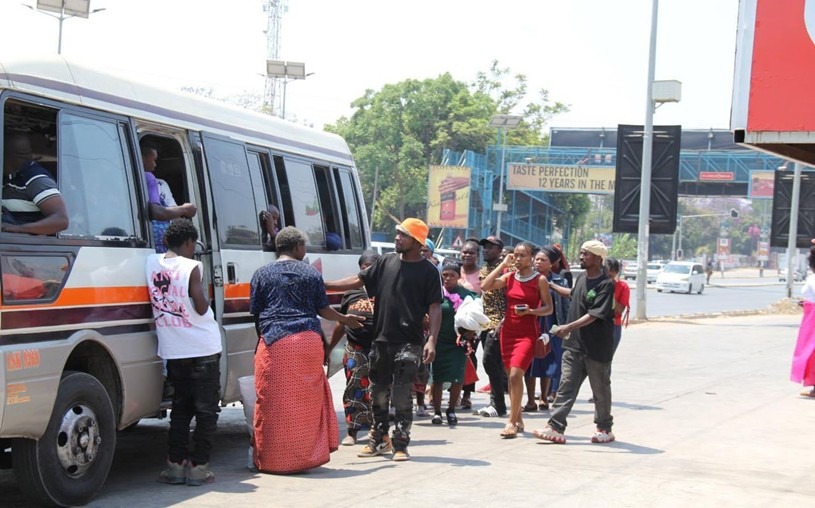
Minibuses carry most of Lusaka’s public transport trips. The study looked at how this fleet could move to electric.
Independent sources
- ZAMBIAeMOBILIZE project page on zemia.org, listing the Techno-Socioeconomic Analysis for EV Bus Transportation Network Development in Zambia as a project work package ↗
- Technext, August 2023: ZEMIA named among Drive Electric LEAP Fund grantees ↗
- ClimateWorks Foundation: the Drive Electric LEAP Fund ↗
- The final report was submitted to ZEMIA in January 2025 for its funder report and has not been published online. A copy is available from ZRST on request: info@zambianroadsafety.org
Inclusive Climate-Resilient Transport in Africa (HVT046)
Participatory research on how Lusaka’s roads can serve disadvantaged road users and stand up to a changing climate
What ZRST delivered
ZRST led the Lusaka case study, using street surveys and participatory mapping around Tokyo Way in Kamwala South.
What the evidence shows
More than 80% of users surveyed at the 3D crossing reported feeling safe or very safe. The locally available paint faded within about six months. The survey measured perceived safety.
Who can verify it
The Stockholm Environment Institute’s HVT046 project record documents ZRST’s role, the Lusaka case study and its published outputs.
Objectives
- Understand the mobility needs of disadvantaged groups in Ethiopia, Rwanda, Uganda and Zambia.
- Test creative participatory tools for transport planning in Lusaka and Kampala.
- Produce guidance and train planners in inclusive, climate-resilient transport planning.
Key findings
- Policies for disadvantaged groups are missing or poorly implemented, and planners and disadvantaged groups disagree about how well they work.
- Disadvantaged groups have little chance to take part in planning, and climate risk and resilience get low priority.
- In Lusaka, over 80 percent of users felt safe or very safe on the 3D crossing, but locally available paint faded within about six months.
What the project does
Walking is the main way most people in Lusaka travel, yet roads have long been planned around cars, and heat, floods and air pollution add to the risks that pedestrians already face. This 24-month study asked how African transport planners can hear the voices of disadvantaged groups, including older people, women, children and people living with disabilities, and build infrastructure that copes with climate change. It ran a needs assessment in Ethiopia, Rwanda, Uganda and Zambia, drawing on more than 200 stakeholders, tested creative participatory methods in Lusaka and Kampala, and produced practical guidance and training for planners.
What ZRST delivered
ZRST led the Zambian research. With permission from Lusaka City Council, the team ran the Lusaka case study at the Tokyo Way and Kamwala South junction, one of the city’s most dangerous crossings for schoolchildren, and extended it to junctions on Burma and Chilimbulu roads used by pupils. In July 2021 more than 40 residents marked their risks on paper maps at the roadside. The team also recorded digital stories with an ice cream vendor, a woman trader, a school pupil and a wheelbarrow pusher, ran a Delphi survey with 22 planners and representatives of disadvantaged groups, and painted a 3D zebra crossing to test whether it would slow drivers. The street work was covered on Zambian television.
On 12 and 13 May 2022 ZRST hosted the national training workshop at the Radisson Blu Hotel, Lusaka, opened by the Minister of Transport and Logistics, Hon. Frank Tayali, MP. Delegates from government, Zambia Police, Lusaka City Council, RDA, RTSA, universities and disability organisations signed a nine-point communiqué asking for people with disabilities to be included in road design decisions, for walking and cycling to come first, for a review of the Road Traffic and Transport Act, and for road-use data broken down by gender and disability. Daniel Mwamba is a named co-author of the project’s needs assessment, its practitioner guidance and a 2024 peer-reviewed article in the journal Cities.
The 3D crossing had effects beyond the study. Prudential Life Assurance asked ZRST to paint four more, outside Mumuni Primary School, Prudential House on Thabo Mbeki Road, and Kamwala and Libala secondary schools on Chilimbulu Road. In an evaluation reported by the project, over 80 percent of people using the crossing said they felt safe or very safe, and Lusaka City Council asked for another on Cairo Road. The water-based road paint available locally faded within about six months, so the project closed with a proposal to test longer-lasting thermoplastic paint.
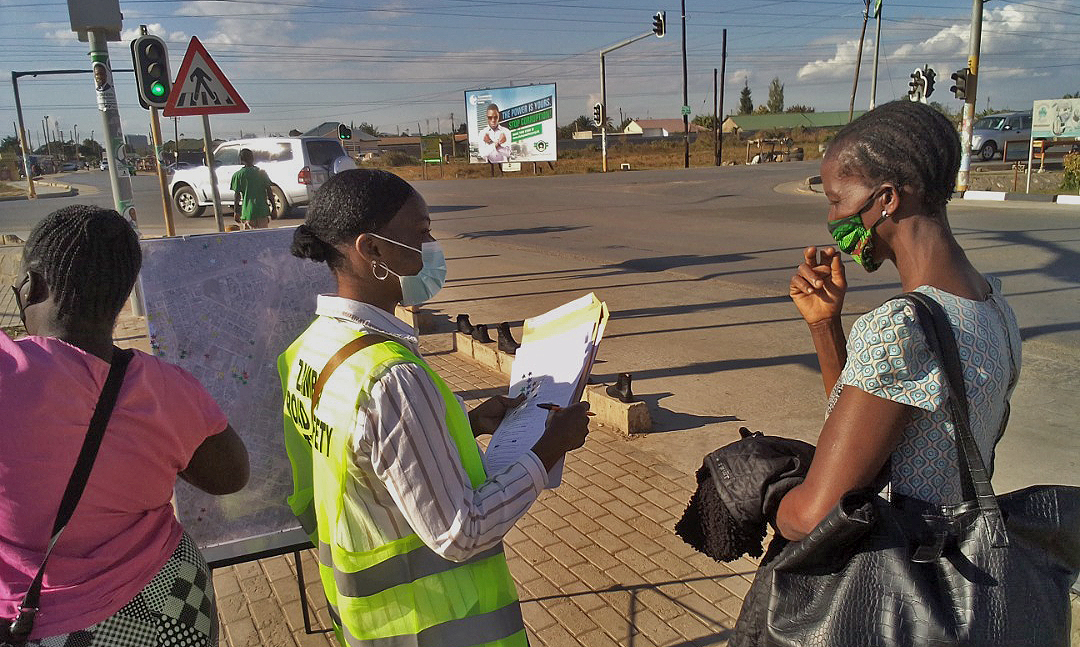
A ZRST researcher talks to a resident during the on-street mapping survey.
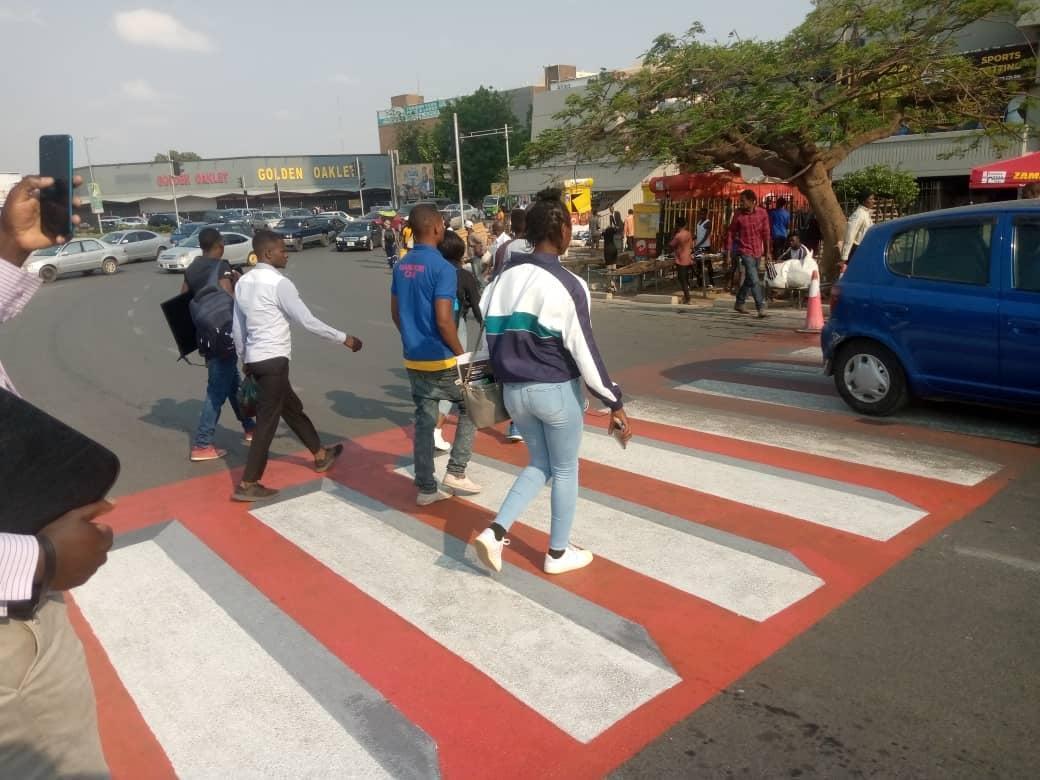
Pedestrians on a 3D zebra crossing, the creative method tested in the case study.

Daniel Mwamba hands the workshop report to Hon. Frank Tayali, MP, Minister of Transport and Logistics.
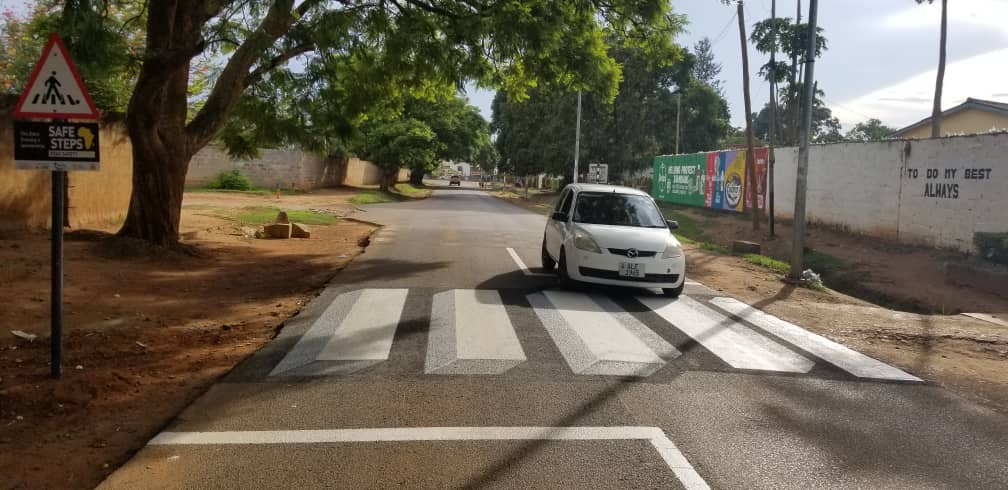
One of the four follow-on 3D crossings requested by Prudential after the study.
Fieldwork in Lusaka
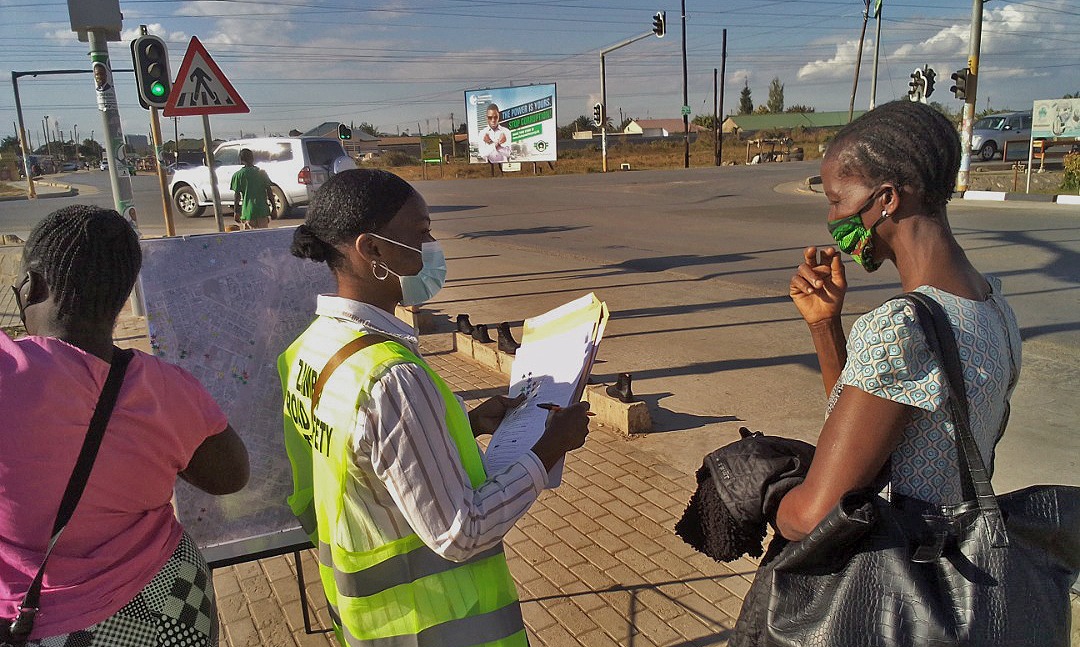
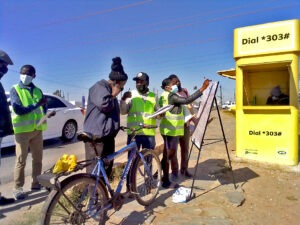
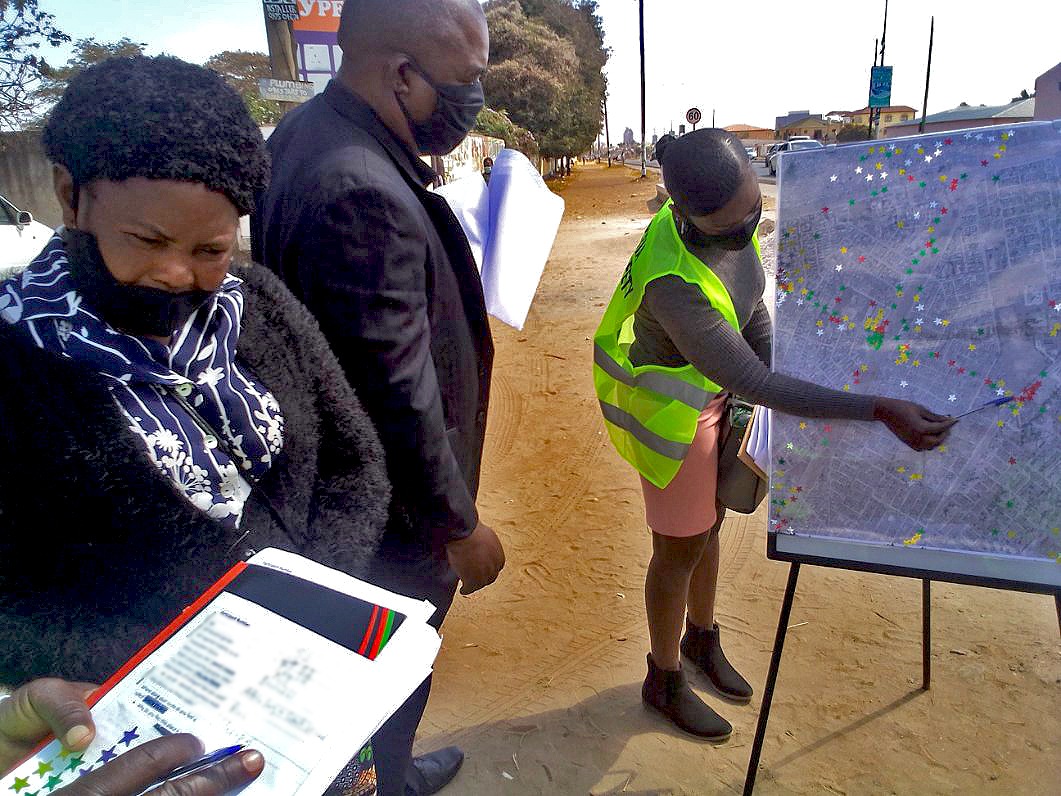
Photographs by Daniel Mwamba / Zambia Road Safety Trust. Source: Stockholm Environment Institute’s HVT046 case study.
Independent sources
- SEI project page, naming the Zambia Road Safety Trust as research partner ↗
- Needs assessment, 2021 (Haq, Muhoza, Njoroge, Mwamba, Arby and Ngabirano) ↗
- The same needs assessment on GOV.UK Research for Development ↗
- Using Creative Participatory Approaches for Inclusive Climate Resilient Transport in Africa: Guidelines for Practitioners, 2022 ↗
- Cinderby et al. (2024), Inclusive climate resilient transport challenges in Africa, Cities 146 ↗
- Follow-on Pan-African capacity building programme, final report, 2024 ↗
Humanitarian OpenStreetMap Team
Climate Resilience Planning with Digital Mapping, Lusaka
What ZRST delivered
ZRST and residents mapped flood, drainage and walking-route risks across five Lusaka communities and trained 25 local trainers.
What the evidence shows
The project report records use of the drainage information in priority discussions in three communities. The work produced map data and training, with flood-loss outcomes outside its scope.
Who can verify it
Open Mapping Hub Eastern and Southern Africa documents the grant programme. ZRST’s case study describes the local work and reported use.
Objectives
- Map flood, drainage and walking-route risks with residents of five Lusaka settlements.
- Put the data on OpenStreetMap where councils and communities can use it.
- Train local people to collect, edit and check map data.
Key findings
- 25 local trainers were trained in data collection, editing and validation.
- Civic leaders in Kanyama, Mtendere and Mazyopa used the drainage information when setting flood priorities.
- The project did not build drainage works or measure a fall in flood losses; its gain was visible local risk and local mapping skills.
What ZRST delivered
ZRST worked with residents of Kanyama, Bauleni, Kalikiliki, Mtendere and Mazyopa to map the places where flooding, poor drainage and everyday walking routes meet. The project combined community meetings, field and remote mapping on OpenStreetMap and Mapathons, and trained 25 local trainers in data collection, editing and validation.
The final report records civic leaders in Kanyama, Mtendere and Mazyopa using the drainage information when they considered flood priorities. The project did not build drainage works or measure a fall in flood losses or injuries. Its contribution was making local risk visible and building local mapping skill.
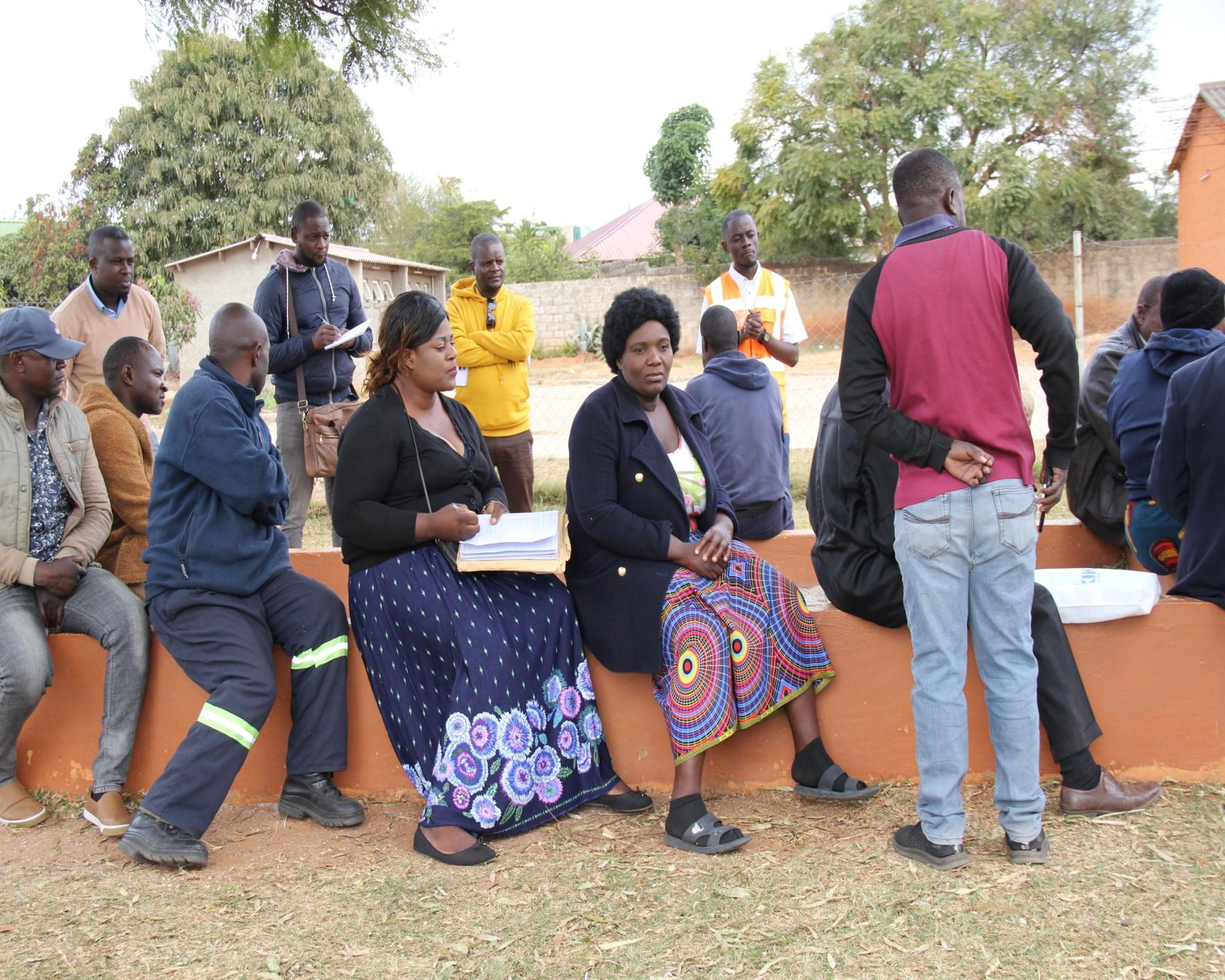
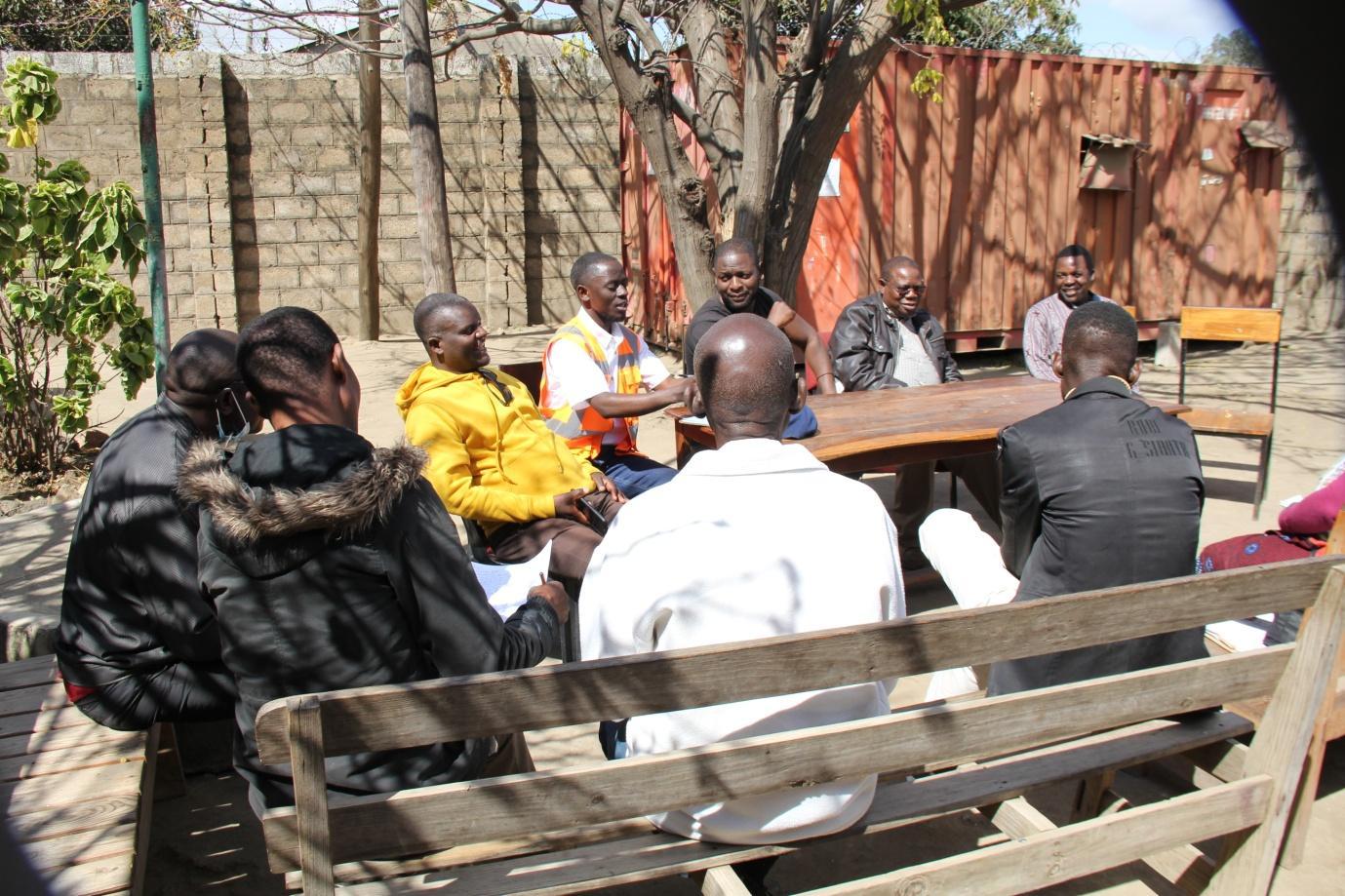
Community participants discuss flood, infrastructure and mobility concerns. Photo: ZRST.
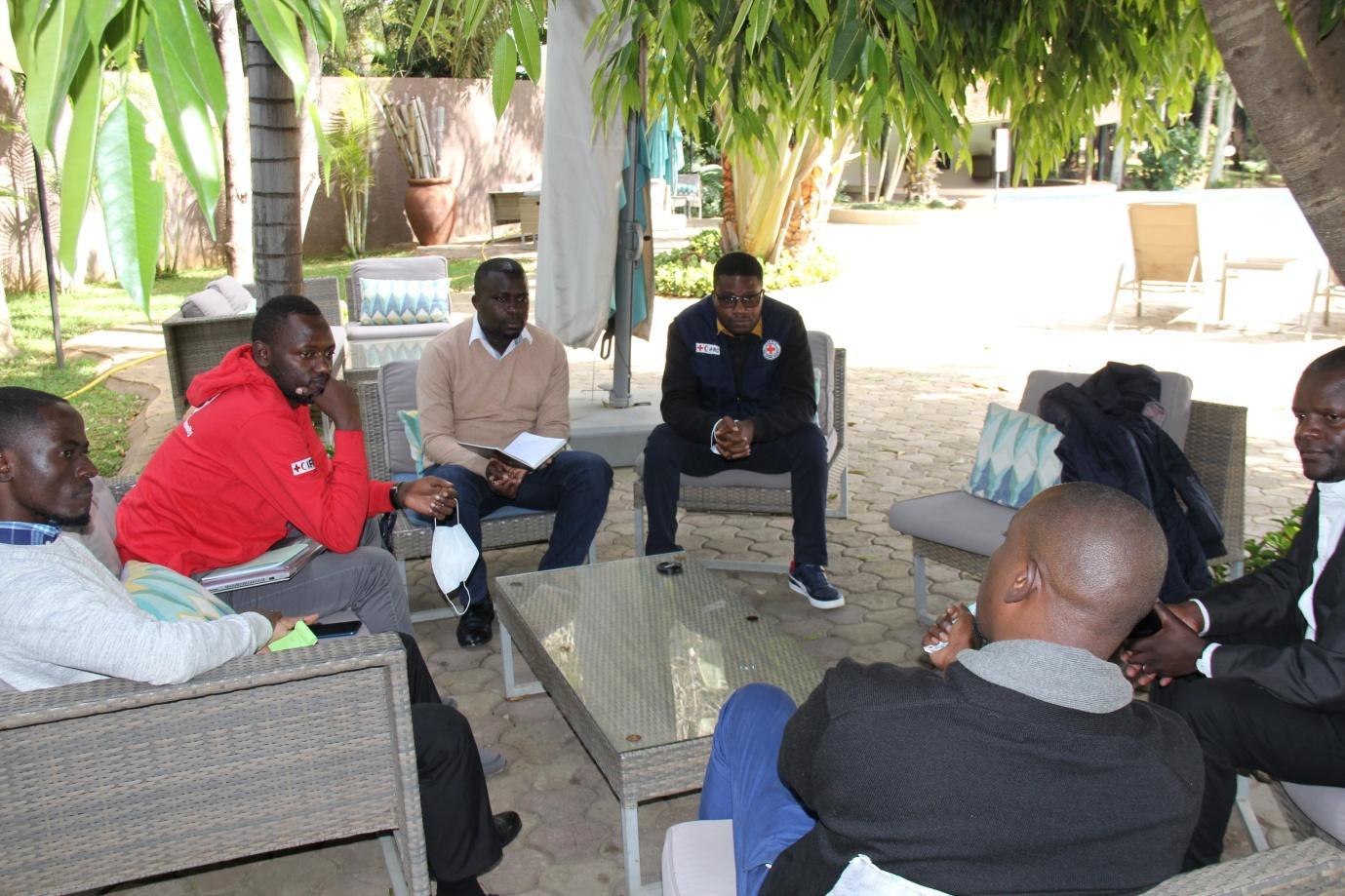
A small group shares local knowledge. Photo: M. Osunga © ZRST.
Residents and participants during community evidence gathering. Photo: D. Luswata © ZRST.
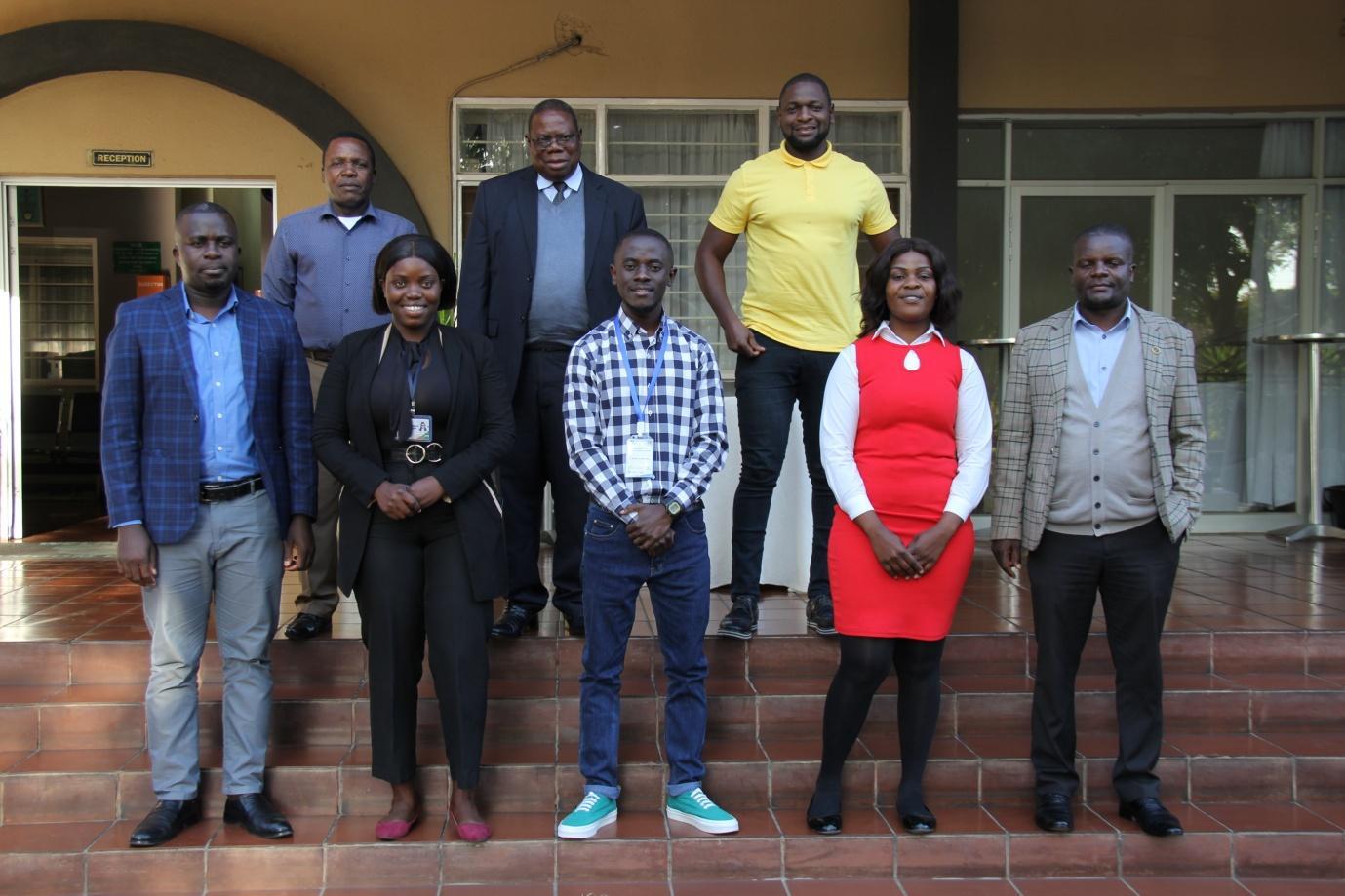
ZRST staff and project participants. Photo: O. Chilekwa © ZRST.
Independent sources
Bridges to Prosperity
Zambia Rural Transport Analysis
What ZRST delivered
ZRST completed a rural transport desk review for Bridges to Prosperity in October 2022, covering trail bridges, policy, stakeholders and financing.
What the evidence shows
The review identified gaps in rural access and potential financing sources. Its findings are based on desk research.
Who can verify it
Bridges to Prosperity commissioned the review. Contact ZRST to request the report or a reference from the commissioning organisation.
Objectives
- Analyse Zambia’s rural transport sector, with a focus on trail bridges.
- Support data collection for B2P’s digital assessment tool in Zambia.
- Identify the policies, stakeholders and finance available for rural access.
Key findings
- Road investment has focused on towns, leaving rural roads underdeveloped.
- Transport makes up as much as 60 percent of the cost of some goods, and rural people depend on crowded, unpredictable and costly public transport.
- Mining, at 12 percent of GDP and 70 percent of exports, is an untapped partner for rural infrastructure, alongside funding from RDA, JICA, the Constituency Development Fund, the World Bank, the EU, AfDB and the National Road Fund Agency.
What ZRST delivered
Bridges to Prosperity builds trail bridges that connect isolated rural communities to schools, clinics and markets. In 2022 B2P commissioned ZRST to carry out an independent analysis of Zambia’s rural transport sector to inform its work in the country.
ZRST’s desk review, completed in October 2022, covered rural transport modes and trail bridges, poverty, inequality and climate change, the policy and legal framework, a stakeholder analysis of the sector, and the financing available from the Road Development Agency, JICA, the Constituency Development Fund, the World Bank, the European Union, the African Development Bank and the National Road Fund Agency. The report’s authors are Daniel Mwamba, Euphrasia Chilongoshi Simutami and David Kafwamba.
Publications and research outputs
Peer-reviewed publications (ZRST co-authored)
A six-country study (Tanzania, Ghana, Zambia; Norway, Netherlands, Sweden) drawing on focus groups, fieldwork and surveys of more than 1,800 pedestrians. It finds that pedestrian safety in the African countries depends not only on Safe System infrastructure but also on cultural factors such as the social status of pedestrians — so policy must address both.
DOI: 10.55329/fqxm8031 Download PDF Article pageBased on surveys of 3,772 drivers and pedestrians plus interviews and fieldwork across the same six countries. It identifies fatalistic beliefs about road safety and the low social value placed on walking as the biggest culture gaps between the African and European countries, and links fatalistic beliefs to violations and crash involvement.
DOI: 10.55329/bbmj5348 Download PDF Article pageConference papers
Presents measured before-and-after results from ZRST’s 15-site Lusaka living lab: vehicle speeds down more than 30%, unsafe road-crossing by pupils down 20%, road-safety knowledge up about 80% among 24,000+ pupils, and all 15 school zones reaching a 3-star iRAP pedestrian rating.
Download paper (PDF) ConferenceProject research deliverables
Public deliverables from the EU research projects ZRST contributes to. Authorship is consortium-level; ZRST contributed Zambian data and fieldwork.
| Project Deliverable | Project | Year | Link |
|---|---|---|---|
| D5.2 — Mapping of Road Safety Culture | AfroSAFE | 2024 | via AfroSAFE / Lund University |
| D5.3 — Human factors and accident causation in selected African countries | AfroSAFE | 2024 | via AfroSAFE / Lund University |
| D1.1 — Project Plan | AfroSAFE | 2022 | |
| Lusaka living-lab / Safer Journeys to School (WP4) | TRANS-SAFE | 2024–26 | Project Deliverable |
Case studies & studies featuring ZRST’s work
Related reading
Road Safety in Zambia: Investment Case (UNDP Zambia, 2023).
Our researchers
Daniel Mwamba — CEO/Executive Director, Zambia Road Safety Trust. Twelve-plus years in road safety; Safe System / Vision Zero advocacy, speed management, school-area safety and protection of vulnerable road users.
Thomas Miyoba — Research & Partnerships Manager and Director of the Road Traffic Victims Fund; leads AfroSAFE in Zambia. Public health specialist, geographer and GIS expert; peer reviewer for Traffic Safety Research and the Journal of Interventional Epidemiology and Public Health; part-time lecturer, University of Zambia School of Public Health (ORCID 0000-0002-9507-2490).
Chilekwa O’Brien — Research & Evaluation; lead author of the Lusaka 15-site school-zone results.
Other research collaborations
Great North Road school safety: Serenje to Chinsali
Safe Schools Africa corridor assessments in Zambia, 2024–2026
What ZRST delivered
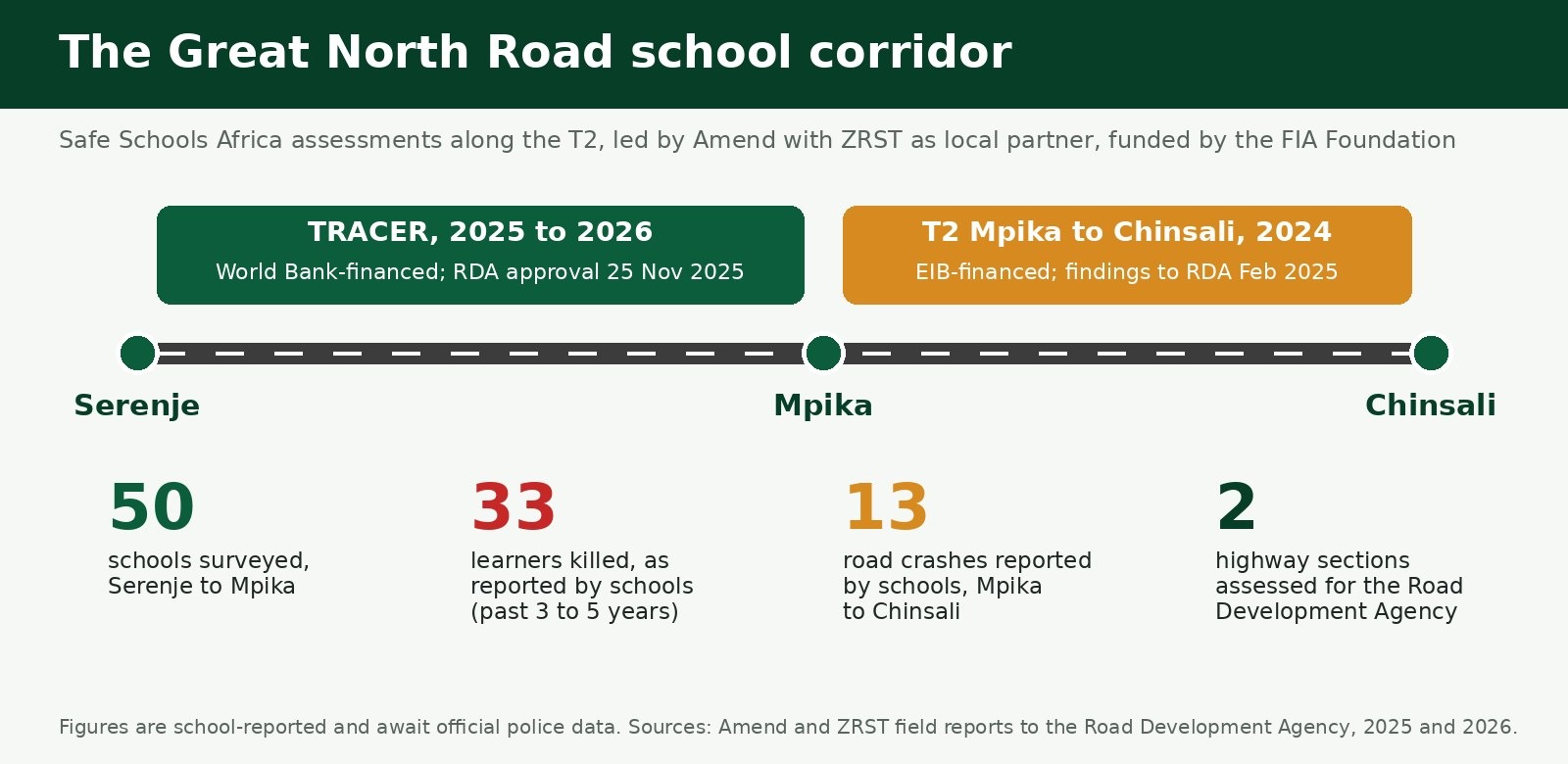
ZRST provided the local field team for Amend’s FIA Foundation-funded Safe Schools Africa work with the Road Development Agency (RDA). The team assessed school access, crossing points and road risk along two sections of the T2.
What the evidence shows
School reports identify risks along both sections. The records cover different groups and reporting periods, so the figures are presented separately. Police reconciliation was requested for Serenje–Mpika.
Who can verify it
Amend and the RDA can confirm the fieldwork and recommendations. Zambia Police crash records are the source for reconciling school-reported incidents. Contact ZRST to request the underlying records or a partner reference.
Mpika to Chinsali, 2024–2025
On the European Investment Bank-financed rehabilitation section, the team reviewed road designs and mapped schools in Mpika, Shiwang’andu and Chinsali. Fieldwork covered pupil journeys, crossing points, speeds, pedestrian and vehicle counts, and school-reported incidents. Drone footage from selected sites was analysed using GoodVision to identify crossing patterns and potential conflicts with vehicles. Findings and recommendations were presented to RDA engineers on 25 February 2025.
Schools reported 13 incidents involving pupils or community members, with seven injuries and six deaths. Trucks were involved in several reports. Some schools were within 10 to 50 metres of the highway.
Serenje to Mpika, 2025–2026
On 25 November 2025, the RDA accepted Amend’s proposal for an assessment on this World Bank-financed TRACER section. FIA Foundation funding covered the assessment. The team visited 50 schools in Serenje, Chitambo, Lavushimanda and Mpika districts, recording their proximity to the highway, enrolment and crashes recalled over the previous three to five years.
Schools reported 33 learner deaths, 46 adult deaths and 28 serious injuries on the project road. One primary school near Mpika, 220 metres from the highway, reported 18 incidents, including learner deaths in 2023, 2024, 2025 and January 2026.
The RDA requested detailed assessment at priority schools, including speed surveys and drone video. The planned recommendations cover crossings, footpaths, speed management and school-zone treatments for consideration in TRACER designs. Any construction support would help the project team confirm where pupils cross.
Digital Transport for Africa / WRI — Zambia Flexible Research Fund
What ZRST delivered
ZRST supported stakeholder engagement, road safety inspections and walking and cycling audits in Lusaka.
What the evidence shows
The work produced mapping and field evidence for transport planning. Published consortium outputs include a transit map and a policy paper.
Who can verify it
DigitalTransport4Africa documents ZRST’s role. Transport for Cairo publishes project outputs.
COMESA Truck Rest Hub Network — pre-feasibility & concept-validation study (in progress)
What ZRST delivered
ZRST is preparing a pre-feasibility and concept-validation study for truck rest hubs on the Zambian sections of the North–South and Tanzam corridors.
What the evidence shows
The work is in progress. Feasibility findings and any effects on driver fatigue or crashes are pending.
Who can verify it
Contact ZRST for the current scope and status of the study.
Road Safety Impact Assessment (RSIA) pilot & Road Safety Audit training
What ZRST delivered
ZRST is working with Lund University on a Road Safety Impact Assessment pilot and supported Road Safety Audit training with the Road Development Agency in 2025.
What the evidence shows
The portfolio records the pilot and training. Pilot findings and measured changes in audit practice are pending public documentation.
Who can verify it
Contact ZRST for the pilot record, training documentation and partner reference details.
High Volume Transport (HVT) research — University of York & Stockholm Environment Institute
What ZRST delivered
ZRST supported Lusaka fieldwork, including stakeholder interviews and focus groups, with the Stockholm Environment Institute at the University of York.
What the evidence shows
The portfolio documents fieldwork and consultation. Findings specific to this entry are pending a linked publication.
Who can verify it
Contact ZRST for the project record and the relevant University of York or SEI reference.
STEGA project — De Montfort University (UK)
What ZRST delivered
ZRST worked with De Montfort University on road safety public engagement in Zambia in 2020–2021.
What the evidence shows
The portfolio records the engagement activities. Measured outcomes are pending public documentation.
Who can verify it
Contact ZRST for available activity records and a De Montfort University reference.
ZRST–University of Zambia (UNZA) research framework
What ZRST delivered
ZRST and the University of Zambia established a research collaboration framework and co-hosted AfroSAFE activities.
What the evidence shows
The June 2026 AfroSAFE conference documents joint delivery. Findings from individual studies are reported in their own publications.
Who can verify it
The AfroSAFE Academy conference record identifies UNZA and ZRST as organisers. Contact ZRST for the collaboration framework.