The ZRST Method
From road safety risk to implemented protection
ZRST works with schools, councils, government institutions, companies, donors, technical partners and communities to move road safety from discussion to action.
The method is straightforward: understand the risk, bring the right people together, support practical measures, train the users, and report the evidence honestly, including its limits. What separates it from a one-day awareness event is that every step is defined, assigned and open to challenge.
Risk. Agreement. Protection. Evidence. ZRST links assessment, institutional responsibility, practical delivery and honest reporting.
Why it matters
Road safety projects need a delivery method, not only good intentions.
Road safety work fails when it is treated as a single awareness day, an isolated piece of infrastructure or a policy announcement with no follow-through. Before ZRST presents anything as a solution, it looks at the road environment, the people exposed to danger, the institutions that must approve action, and the measures that can actually be delivered in the local context.
Understand the risk
Review data, site conditions, road-user behaviour, school routes, traffic movement and community concerns.
Build agreement
Engage the schools, councils, authorities, funders, companies and communities needed for action.
Support protection
Propose practical measures, support approvals, assist implementation, and train users or institutions.
Report responsibly
Document what was done, who contributed, what evidence exists, and what still needs attention.
Evidence and claims discipline
What we claim, and what we do not claim yet.
We hold every claim to the weakest honest description, so a reviewer finds the caveats already stated rather than having to expose them.
What we claim
- The method is built from measures with strong international evidence: 30 km/h zones, raised crossings, footways and speed management.
- One independent before-and-after study, run by Sweden’s national transport research institute VTI against a control school in Zambia, supports the approach at a single site.
What we do not claim yet
- No proven national or worldwide standard, and no casualty reductions. The complete system has not been run with a comparison group and a full published dataset.
- We will call the method proven only when four conditions are met: a completed pilot with comparison corridors and a published dataset, reductions that hold at the twelve-month follow-up, at least one council running a second wave from its own budget, and independent verification of the results and the costs.
Flagship application
The Safe School Corridors Delivery Standard.
The method’s most developed form is a costed, measurable system that helps a council decide which school routes to fix first, what to build, what it should cost, whether the work reduced risk, and who keeps it safe afterwards. It is not another school-zone project. It is the operating system that makes school-zone projects consistent, measurable and affordable, organised into sixteen defined components.
How we know whether it worked
Building something is easy to prove. Reducing risk is not. The standard measures a defined set of indicators before and after treatment, and against untreated comparison corridors, so a fall in speeds can be attributed to the work and not to a citywide trend or the weather. We do not rely on crash counts alone, because a single corridor rarely records enough crashes in a year to show a reliable change. The main indicators are 85th-percentile speed, the share of vehicles over 30 km/h, driver yielding, pedestrian-vehicle conflicts and crossing wait times.
The evidence behind it
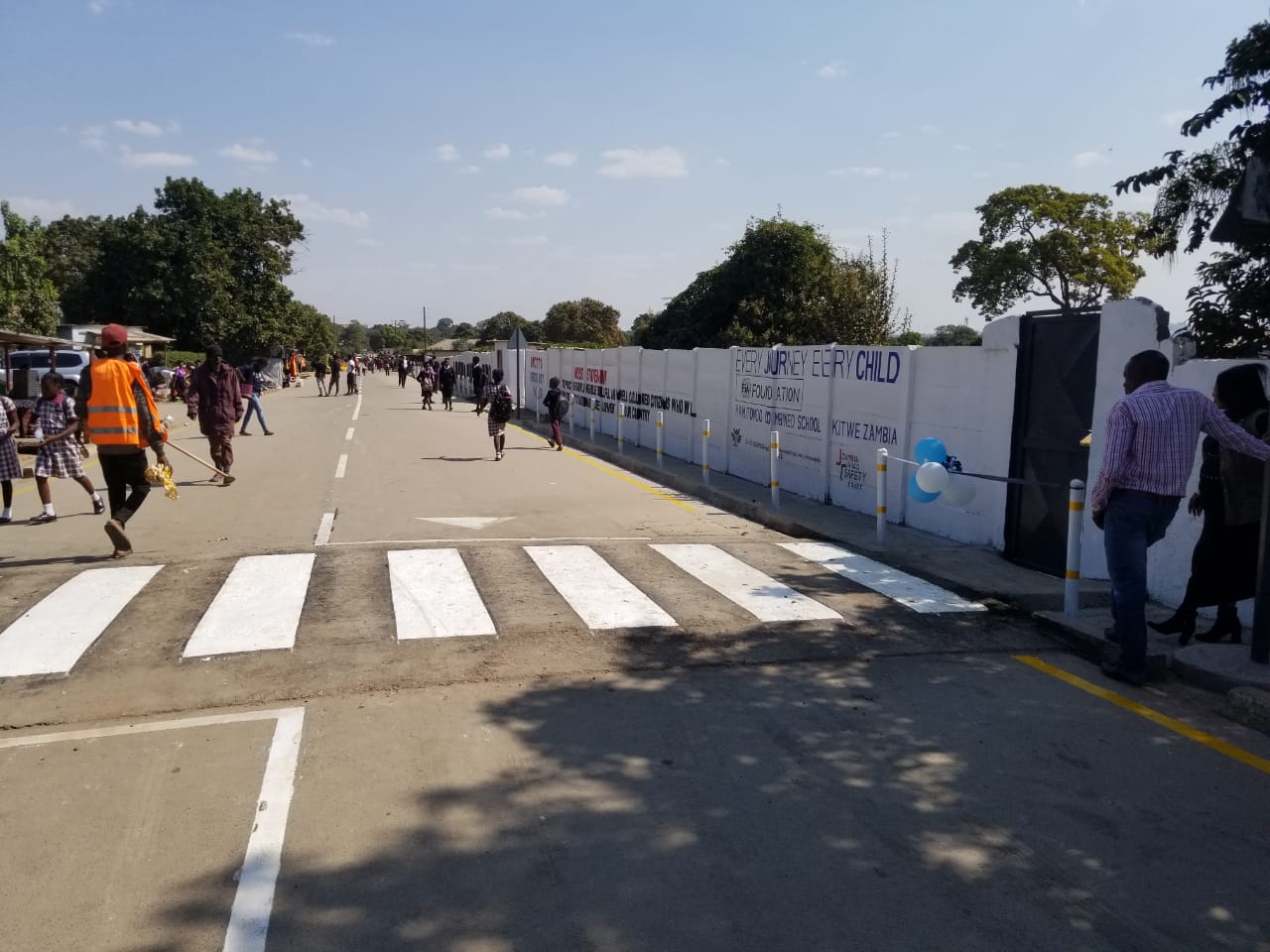
The strongest evidence we hold is not ours to mark. VTI evaluated a treated school corridor against a control school in Zambia under the EU-funded AfroSAFE programme, and the study was quality-checked by the Institute of Transport Economics. Alongside it sits our own before-and-after observation at a treated school, where average speed fell from 51.3 to 35.8 km/h. That figure is honest and limited: one site, a short follow-up, and a result that still sat above the 30 km/h we were aiming for. We treat it as supporting evidence, not proof.
Primary study: Forward S, Henriksson P, Silvano AP, Miyoba T, Sinkala S, Mawele S, Mwamba D. Increasing traffic safety at schools in Zambia: a before and after study. VTI Report 1226A, 2025.
Where it applies
One method, several road safety settings.
The ZRST Method is used across work that involves children walking to school, pedestrians crossing busy roads, cyclists sharing unsafe corridors, motorcycle riders exposed to traffic risk, fleet drivers on dangerous routes, and public institutions trying to act on road safety problems.
Partner confidence
What partners can expect, and what ZRST does not do.
Partners can expect clear scoping, practical stakeholder engagement, site evidence, realistic recommendations, implementation support, training where relevant, documentation, monitoring and responsible reporting. Where a project is delivered by a wider partnership, ZRST credits funders, technical partners, public authorities and implementing organisations properly.
What ZRST does not do
- ZRST does not replace statutory road authorities or approve road works on behalf of councils or agencies.
- ZRST does not treat education alone as a complete solution, or claim results that belong to a wider partnership.
Evidence
The method is linked to ZRST’s public record.
The method is supported by the programme record, governance disclosures, audited accounts, partner-backed success stories and external evidence sources.
The full Global Model Framework (PDF). Programmes & Impact
Programme areas, results and evidence. Governance and Financial Accountability
Board oversight, audit records and due-diligence information. ZRST Evidence Pack
Downloadable evidence pack for partners and reviewers.
A note from the founder
Why this page is careful with its claims.
I want to be straight about why this page is so careful with its claims. At one school we treated, average speeds fell from 51.3 to 35.8 km/h. The first time I saw that number I wanted to put it on a banner. Then I looked again: 35.8 is still above the 30 we were aiming for, it came from one site, and we had no comparison group in our own record. So the number is honest, and it is not enough. Publishing a figure that is not good enough yet costs us the easy headline, and I would rather lose the headline than the trust. If the pilot shows the method does not work, we will say so on this same page.
Daniel Mwamba
Founder and Executive Director, Zambia Road Safety Trust
Work with ZRST
Use a clear road safety method, from risk to protection.
We work with donors, companies, councils, schools, government institutions and technical partners to identify road safety risks, develop practical interventions, support implementation and report evidence responsibly. We would rather show you the evidence than sell you a promise.
Cite this standard: Zambia Road Safety Trust (2026). Safe School Corridors Delivery Standard: Global Model Framework, Version 1.0. Lusaka: ZRST. RNGO 101/0503/2015.