Zambia Road Safety Trust
Zambia’s Children Deserve Safer Journeys to School
Guest Article
Every morning, across Zambia, children step out of their homes and begin a journey that should be simple. They walk to school. They cross busy roads. They move past minibuses, motorcycles, private cars, trucks, open drains, poor crossings and drivers in a hurry.
For many families, this journey is so ordinary that the danger has become invisible. But the numbers tell a harder truth. In Zambia, the trip to school is one of the most important road safety challenges facing the country.
In 2024, Zambia recorded more than 35,000 road traffic accidents and 2,199 road deaths, according to figures cited by the Zambia Road Safety Trust. Police data also reported 1,310 child casualties under the age of 16 in road traffic accidents that year. In 2025, the situation worsened, with reported fatalities rising to 2,567 deaths nationwide.
These are not abstract statistics. They are children who did not return home. They are parents who received the call every family fears. They are classrooms with empty desks.
Children are not small adults
Children do not read traffic the way adults do. Their judgement, speed perception, risk awareness and ability to react under pressure are still developing. A child may see a vehicle but misjudge how fast it is approaching. A child may assume that a driver has seen them. A child may follow friends into the road without fully understanding the danger.
This is why school road safety cannot depend only on telling children to “be careful”. That is a weak national strategy. Children will make mistakes because they are children. The road system must be designed to protect them when they do.
That means lower speeds around schools, visible crossings, raised zebra crossings, footpaths, warning signs, safe drop off areas, pedestrian gates and proper enforcement. It also means changing the behaviour of drivers, parents, bus operators, motorcycle riders and communities.
The World Health Organization has repeatedly emphasised that traffic calming around schools saves lives. In Lusaka, school zone improvements that included crosswalks, speed bumps and sidewalks reduced average vehicle speeds from 38 km/h to 12 km/h at one school, and from 22 km/h to 18 km/h at another.
That is the difference between a child surviving a collision and a family planning a funeral.
The school gate has become a danger zone
Across Lusaka and other Zambian towns, many schools sit directly on busy roads. At opening and closing times, the road environment changes quickly. Children gather at gates. Parents stop suddenly. Minibuses compete for space. Vendors occupy edges of the road. Motorcycles weave through traffic. Drivers become impatient.
The result is a dangerous mix of congestion, speed, poor visibility and weak infrastructure.
In many school areas, the basic protective elements are still missing. There are no continuous footpaths. Crossings are faded or absent. Speed limits are not clearly posted. Where signs exist, enforcement is often inconsistent. Children are left to negotiate with traffic instead of being protected from it.
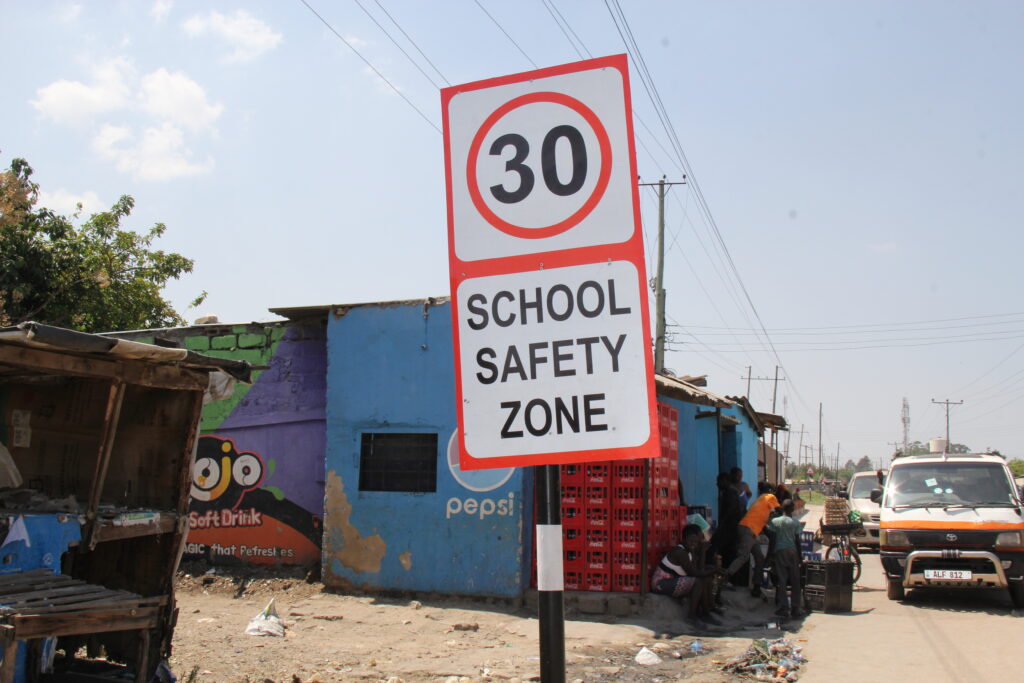
This is why the Zambia Road Safety Trust has consistently argued for 30 km/h school zones, safer pedestrian crossings and practical infrastructure that slows vehicles before they reach school gates. ZRST has also supported safe infrastructure around high risk schools, including speed humps, footpaths, raised and painted zebra crossings, warning signs, road markings and pedestrian gates.
The lesson is clear. Education matters, but education without safe infrastructure is not enough.
Zambia has already shown that change is possible
This is not a problem without solutions. Zambia already has examples of what works.
Lusaka City Council has moved towards improving school zones through zebra crossings and 30 km/h speed limit signs. UNDP Zambia has also supported school safety improvements, stressing that speeds of 30 km/h or less around schools are essential where there is high pedestrian activity.
ZRST’s work with partners has shown that road safety can be practical, local and measurable. Through school-based programmes, infrastructure advocacy and community engagement, ZRST has helped shift the conversation from awareness alone to safer systems around children.
The VIA Safe Mobility Programme, launched with TotalEnergies Foundation support, is one example. It targets 10 schools in Lusaka and aims to reach more than 20,000 learners through road safety education, peer learning and safer mobility awareness.
This matters because children are not only victims of unsafe roads. They can also become road safety ambassadors in their schools, homes and communities. But again, we must be honest, child education cannot compensate for reckless speeding, poor crossings or roads designed only for vehicles.
The wider African context should worry Zambia
The crisis is not only Zambian. Across Africa, road traffic injuries remain a major public health problem. The WHO African Region recorded an estimated 225,482 road traffic deaths in 2021. Africa carries 19 percent of global road traffic deaths despite having only 15 percent of the world’s population and just 3 percent of the world’s vehicles.
This is the uncomfortable point Zambia must face. As vehicle ownership rises, cities expand and motorcycles become more common, the country cannot wait for deaths to rise before acting. Prevention is cheaper than emergency care. A raised crossing is cheaper than surgery. A 30 km/h school zone is cheaper than a funeral. A protected walking route is cheaper than lifelong disability.
What Zambia should do now
First, every school on a high risk road should have a basic safety assessment. This does not require a complicated national study before action begins. Local authorities, RTSA, police, schools and organisations such as ZRST can identify the most dangerous school corridors and start with practical improvements.
Second, 30 km/h school zones should become standard around schools, not occasional pilot projects. A school zone that depends on goodwill alone will fail. It needs signs, traffic calming, enforcement and public communication.
Third, school infrastructure must be funded. Zambia cannot continue treating pedestrian safety as an optional extra. Lusaka’s decision to ringfence part of parking levy revenue for walking and cycling infrastructure is the kind of local financing mechanism that should be expanded and protected.
Fourth, road safety education should be part of school life. Children need age appropriate lessons on crossing, visibility, safe walking, cycling, public transport and passenger behaviour. Parents also need guidance, especially on dangerous drop off behaviour near school gates.
Fifth, corporate Zambia should stop treating road safety as charity and start treating it as social investment. Banks, insurers, fuel companies, logistics firms, mines, manufacturers and telecoms all depend on safe transport systems. Supporting safe school corridors is not public relations, it is a direct investment in the communities that sustain their businesses.
A child’s journey to school should not be a test of survival
The measure of a serious country is not how fast its vehicles move, but whether its children can cross the road safely.
Zambia has the knowledge. It has committed institutions. It has examples of success. What is still missing is scale, financing and political urgency.
The Zambia Road Safety Trust has shown that safer school journeys are possible when infrastructure, education, community engagement and public leadership come together. The next step is to move from isolated interventions to a national programme of safe school corridors.
Every child should be able to walk to school without fear. Every parent should expect their child to return home. Every school gate should be a place of learning, not a point of danger.
That is not too much to ask. It is the minimum Zambia owes its children.