Safe School Corridors Practitioner Course
A three-day, field-based professional course that helps municipal and partner teams assess school-route risk, rank corridors, select suitable measures, prepare preliminary costs and define how the work will be measured, maintained and financed.
Participants work through a real municipal decision chain, from readiness and field evidence to a go, adapt or stop recommendation.
Evidence boundary: the course is built from established road-safety components. The complete ZRST framework remains under test and is not presented as an adopted national standard, a proven global model or an externally accredited qualification.
Download the public ZRST Global Model Framework PDF.
School-zone projects fail when each decision is made from scratch.
The framework gives a council one repeatable way to answer six questions before public money, donor finance or corporate support is committed.
A municipal operating system, not a new piece of road infrastructure.
Crossings, footways, 30 km/h environments, signs, markings, traffic calming and school engagement are established measures. The proposed value lies in the disciplined system used to select, cost, deliver, measure, maintain and repeat them.
Readiness and selection
Check municipal capacity, identify candidates, collect field evidence and rank risk.
Treatment and delivery
Match treatments, prepare approvals and procurement, then control construction quality.
Evidence and ownership
Measure outcomes, record unit costs, hand over assets and equip the council to repeat the process.
Finance and scale
Build public finance, national review, inclusive replication and a controlled ZRST custodian role.
Municipal readiness gate
Tests authority, capacity, procurement, maintenance and safeguarding before delivery starts.
Candidate corridor identification
Creates a defensible longlist from enrolment, crash, speed and community evidence.
Rapid risk diagnosis
Uses a repeatable field protocol so candidate corridors are assessed consistently.
Transparent risk score
Ranks corridors against stated evidence rather than visibility or influence.
Modular treatment matrix
Matches a treatment package to the risk and checks contraindications.
Delivery and procurement
Turns the concept into an approval, procurement and implementation workflow.
Build and quality control
Defines supervision, defects, stop-work conditions and completion checks.
Measurement and comparison
Uses repeated before-and-after measurement and comparison corridors.
Unit-cost tracking
Records the true cost per corridor and per child exposed.
Maintenance and asset handover
Assigns ownership, inspection and renewal responsibilities.
Adoption toolkit
Provides forms and templates for a council to run the next wave.
Blended financing
Connects pilot funding to routine public and partner finance.
National adoption pathway
Sets the route to formal review and possible national use.
International replication
Separates the universal core from country and city adaptation.
Inclusive child-centred design
Builds child, gender, disability and safeguarding requirements into delivery.
ZRST custodian role
Places ZRST as trainer, quality assurer and evaluator without replacing the council.
What is established, and what still has to be proved.
Established components
- Safe System principles
- 30 km/h school environments
- Speed management
- Crossings, footways and traffic calming
- Child-centred and accessible street design
- Before-and-after road-safety measurement
Still under test
- The complete end-to-end ZRST delivery framework
- The reliability and weights of the proposed risk score
- Municipal ownership across repeated delivery waves
- Unit costs at scale
- Maintenance follow-through
- National and international replication
ZRST will not claim casualty reduction, cost-effectiveness or a proven national standard until a suitable pilot and independent review support those claims.
Municipal planning, risk assessment, implementation and evaluation.
Who should attend
- Municipal engineers, transport and urban planners
- Road-safety, road-authority and traffic personnel
- Education and public-health officials
- University staff, consultants and researchers
- NGO and monitoring specialists
- Development partners and institutional programme teams
Entry expectation: relevant practical experience in transport, engineering, planning, education, health, project management, local government, data or community work.
What participants should be able to produce
- A municipal readiness finding
- A defensible candidate-corridor longlist
- A completed rapid corridor diagnosis
- An evidence-based risk score
- A conceptual treatment package with contraindication checks
- A preliminary budget and delivery outline
- A monitoring and comparison-corridor matrix
- A maintenance and responsibility plan
- A municipal financing case
- A go, adapt or stop recommendation
Engineering boundary: the course does not authorise a participant to approve road designs. Final engineering and statutory decisions remain with competent authorities and registered professionals.
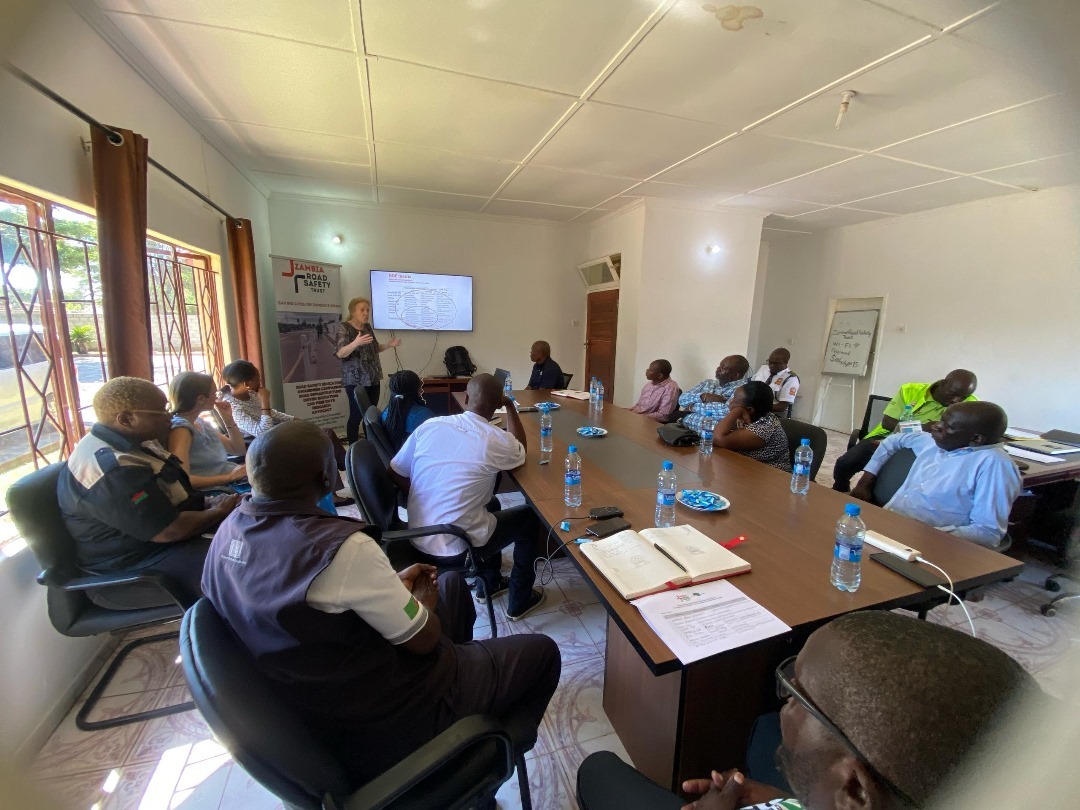
Short lectures, protected fieldwork and applied decisions.
Day 1, readiness and evidence
Safe System, child mobility, the municipal model, readiness, candidate corridors, rapid diagnosis and field preparation.
Day 2, fieldwork and treatment
Supervised school-corridor assessment, data review, risk scoring, treatment selection and inclusive design.
Day 3, delivery and scale
Concept design, costing, procurement, monitoring, unit costs, maintenance, financing, capstone and final assessment.
Safe System and child mobility
Why speed, road design and human vulnerability require a system response.
The municipal delivery model
How prioritisation, treatment, cost, evidence, maintenance and finance fit together.
Municipal readiness assessment
Whether authority, capacity, budget, maintenance and safeguards are ready.
Candidate corridor identification
How to build a corridor longlist from evidence.
Rapid risk diagnosis
What to observe in a 24 to 48 hour corridor assessment.
Data quality and ethical fieldwork
Consistency, privacy, consent, photography and child safeguarding.
Transparent corridor risk score
How to score and defend a corridor ranking.
Modular treatment matrix
How to choose risk-matched measures and check contraindications.
Inclusive and child-centred design
How participation becomes a design requirement.
Preliminary design, costing and implementation
Concept layouts, quantities, approvals, procurement and defects.
Measuring whether the work helped
Indicators that separate outputs from outcomes.
Treatment and comparison evaluation
Baseline, follow-up and comparison-corridor design.
Unit-cost and cost-effectiveness tracking
What to record and how to calculate unit costs honestly.
Maintenance and asset handover
Who inspects, maintains, renews and reports defects.
Financing and adoption
Municipal, national, corporate, donor and development-finance routes.
Go, adapt or stop
How to make an evidence-based decision before replication.
Verified materials, controlled materials and remaining proof.
The curriculum calls itself Document 1 of 10. ZRST Drive records confirm several core products, but the website should not imply that every item in a ten-document set has completed technical review.
| Material | Status | Purpose | Access |
|---|---|---|---|
| Course curriculum | Verified | Public course description | Available on request |
| Trainer manual | Verified | Controlled trainer document | Not included for general distribution |
| Participant manual | Verified | Participant reference text | Included |
| Training slide deck | Verified | Trainer-led classroom delivery | Viewed in class, not transferred automatically |
| Participant workbook | Verified | Exercises, field forms and capstone work | Included |
| Assessment pack | Verified | Tests, rubrics and marking controls | Controlled |
| Course administration pack | Verified | Registration, attendance, records and certificates | Internal |
| Digital marketing content pack | Verified | Recruitment and course communication | Internal |
| Scoring reliability report | Not verified | Evidence that assessors apply the score consistently | Required after pilot |
| External technical review | Not verified | Independent review of the framework, tools and engineering boundaries | Required before wider claims |
Completion requires evidence, not attendance alone.
| Assessment | Weight | Required evidence |
|---|---|---|
| Field assessment | 20% | Complete forms and safe field conduct |
| Risk score and treatment exercise | 20% | Evidence-based score and treatment package |
| Final written test | 25% | Minimum 60% in the written test |
| Group capstone | 25% | Defensible go, adapt or stop recommendation |
| Professional participation | 10% | Attendance, peer review and discussion |
Certificate of Completion: confirms successful completion of the ZRST assessment. Certificate of Attendance: confirms participation only. Neither is a driving licence, engineering licence, statutory approval or external accreditation.
Zambia and regional course fees.
These prices come from the attached ZRST course-pricing model and are treated as launch prices, not a permanent tariff. ZRST should review them after every two cohorts using real delivery cost, demand and quality requirements.
Zambia-based participants
| Category | Fee | Condition |
|---|---|---|
| Individual, standard | K5,500 | Self-funded professional place |
| Early registration | K4,800 | Paid by the published early deadline |
| Government or council | K4,500 | Institutional nomination |
| NGO | K4,500 | Verified organisation |
| University staff | K4,000 | Institutional identification required |
| Student or early-career | K2,500 | Limited selected or sponsored places |
| Corporate, mining or insurance | K9,500 | Commercial HSE or ESG rate |
| Group of 3 to 5 | K4,950 each | One institution, one invoice |
| Group of 6 or more | K4,700 each | Named participants, one invoice |
| In-house Zambia cohort | From K110,000 | Up to 20, venue and local logistics scoped separately |
Regional African participants
| Category | Fee | Condition |
|---|---|---|
| Africa-based individual, NGO or university | US$750 | Course-only rate |
| Regional early registration | US$650 | Paid by the published early deadline |
| Government or municipal officer | US$750 | Institutional nomination |
| Development partner or INGO | US$1,100 | Institutional rate |
| Corporate or international organisation | US$1,400 | Commercial rate |
| Delegation of 4 or more | US$660 each | One invoice |
| In-house course outside Zambia | From US$7,500 | Professional fee, travel and local delivery costs separate |
Commercial safeguard: at K5,500 per paying local participant, the attached model needs about 19 paying places when two scholarship places are included. ZRST should not confirm an under-filled open cohort unless an institution or sponsor covers the shortfall. Scholarship places must have a named funding source.
Clear inclusions prevent disputes.
Included for a Lusaka open cohort
- Three days of tuition and facilitated exercises
- Participant manual and workbook
- Supervised field assessment
- Transport between the venue and approved field site
- Lunch and two tea breaks each day
- Assessment and the applicable certificate
- Digital participant resources
- One group post-course technical session
Not included
- Travel to Lusaka or the delivery city
- Accommodation
- Passports, visas and visa fees
- Medical or travel insurance
- Personal transport and expenses
- Final engineering design or statutory approval
- Post-course consultancy outside the stated group session
- Regional trainer travel, hotel, local transport, venue or interpretation unless quoted
Eight linked technical documents.
The Global Model Framework is available for public download. Controlled drafts and implementation files should be shared through due-diligence or partner access, not open download.
Architecture, principles and claims discipline.
Step-by-step delivery for councils and schools.
Research, comparison design, ethics and measurement.
Forms, scoring sheets, matrices, costing and reporting tools.
Costs, funding pathways and scale scenarios.
Route to Government of Zambia review and council replication.
Country adaptation and institutional capacity requirements.
Major claims, sources, strength, limits and further evidence.
Public knowledge should be accessible, controlled teaching files should remain controlled.
Public or shareable content
- Framework principles and evidence limits
- General delivery sequence
- Public curriculum and module outline
- Published research and evidence register
- Government use with attribution, subject to final terms
Controlled course and quality files
- Trainer manual and slide deck
- Answer guide and marking rubrics
- Quality-review and moderation records
- Certificate register and course administration files
- Any future trainer licence, quality mark or training-of-trainers pack
Legal caution: ZRST should not claim a registered trademark, certification mark or formal licensing system until documentary proof and approved terms exist.
Before registering or commissioning the course.
Is the course accredited?
No external accreditation is currently claimed. Successful participants receive a ZRST Certificate of Completion. Participants who attend but do not meet the assessment standard receive a Certificate of Attendance.
Does the certificate authorise me to approve road designs?
No. Course outputs are conceptual. Final surveys, drainage work, engineering design, approvals and professional sign-off remain with legally competent authorities and registered professionals where required.
Is the framework already proven?
No. It is built from established road-safety components and designed for rigorous pilot testing. The complete end-to-end ZRST framework is not yet presented as a proven national or global model.
Who should attend?
Municipal engineers, planners, road-safety officers, public agencies, school and university staff, NGOs, researchers, monitoring specialists, consultants and development partners with relevant practical experience.
What is included in the Zambia fee?
Three days of facilitated learning, the participant manual and workbook, the supervised field exercise, local transport between the venue and approved field site, lunch and teas, assessment, the applicable certificate, digital resources and one group post-course technical session.
Are accommodation and travel to Lusaka included?
No. Participants arrange and pay for travel to Lusaka, accommodation, visas, medical or travel insurance and personal expenses.
Can an institution book a private course?
Yes. Councils, ministries, universities, NGOs, companies and development projects may request an in-house quotation. Venue, participant number, field site, local logistics and travel requirements are scoped separately.
Can ZRST deliver elsewhere in Africa?
Yes, subject to trainer availability, safe fieldwork arrangements, a local host, travel, tax and logistics. Regional institutional delivery is quotation-based.
Can participants use the tools after the course?
Participants may use the materials issued to them for their own professional work, subject to the stated terms. Trainer manuals, answer guides, quality-control files, course branding and any future licensed toolkit are not transferred automatically.
Is training of trainers available?
Not yet as a public product. It requires approved trainer criteria, observed delivery, moderation, licensing, renewal and withdrawal rules.
Are sponsored places available?
Only when a named sponsor covers the full or partial value. Free places are not created by quietly shifting the cost to paying participants.
Will the course definitely run after I register interest?
No. ZRST confirms a cohort only after the minimum commercial, trainer and field-safety requirements are met and deposits are received.
Register interest, commission a cohort or request regional delivery.
ZRST will confirm the next cohort only after the trainer team, field site, permissions, safety controls, minimum enrolment and payment threshold are met.
Do not send identity records, medical information or sensitive child data through the first enquiry.
Participants should leave with a defensible municipal work product, not only notes and a certificate.
The value of the course is the ability to move from a visible school-road problem to evidence, treatment, cost, ownership and a decision that can survive technical and public scrutiny.