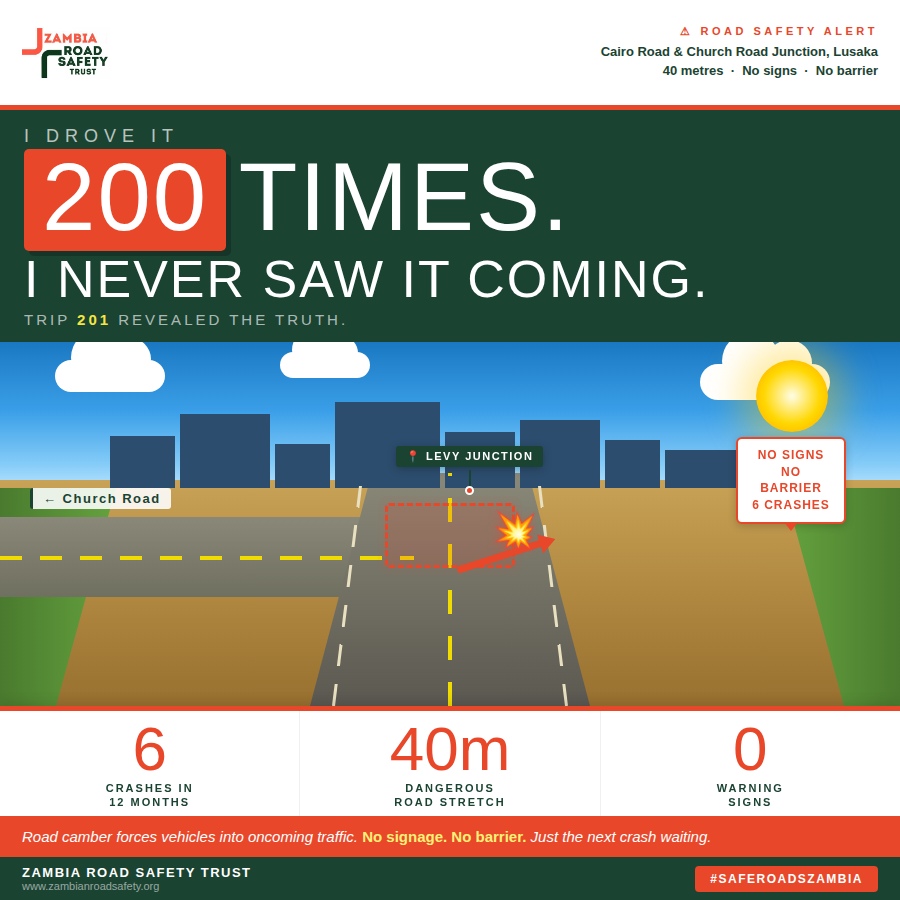
I have driven Cairo Road more than 200 times.
I know its rhythms. The morning congestion near Findeco House, the hawkers at the Kabwata turnoff, the way traffic thins past the bus terminus. I considered myself a careful, experienced driver on that corridor.
Yet on trip 201, I noticed it for the first time.
A 40-metre stretch just past the Levy Junction where the road camber, the physical tilt of the road surface, quietly and mechanically forces vehicles across the centreline and into oncoming traffic on a sharp turn. No warning signage. No barrier. No painted edge line. Nothing to signal that the road itself is working against the driver.
Six crashes were recorded at that single location in twelve months. Six. At one spot. That I had passed, unseeing, two hundred times. We flagged it to the Road Development Agency last month.
This is not a story about one dangerous bend. It is a story about how Zambia’s road safety crisis hides in plain sight, invisible to even its most frequent users, unaddressed by the institutions mandated to fix it, and fatal to the most vulnerable people on our roads.
Zambia loses an estimated 3,000 lives every year to road traffic crashes. The true figure is almost certainly higher. Our crash reporting systems capture fewer than 40% of fatalities, and hospital mortality data remains largely disconnected from road safety planning. Road traffic injuries are the leading cause of death among Zambians aged 15 to 44, our most economically productive citizens, our breadwinners, our parents. The economic cost conservatively exceeds 3% of GDP annually. Those are funds that could build hospitals, schools, and the very roads that are instead destroying lives.
The Cairo Road camber is not a freak anomaly. It is a symptom of a road network built, expanded, and maintained without applying the Safe System principle, the internationally proven framework that designs roads to account for human error. Under this approach, a road must be forgiving. A driver who drifts slightly through fatigue, distraction, or unfamiliar road geometry should not pay with their life or someone else’s. That 40-metre stretch is not forgiving. It is a trap. And it waited patiently through 200 of my trips before I saw it.
How many drivers never got a trip 201?
The evidence is unambiguous. Targeted infrastructure intervention at identified high-risk locations reduces fatalities by 30 to 60% at those sites. Mandatory Road Safety Audits on new and rehabilitated roads, already a legal requirement in Zambia, are inconsistently enforced. A pedestrian struck at 50 km/h has a 75% chance of dying. At 30 km/h, that drops to under 10%. Zambia’s National Road Safety Policy commits to a 50% reduction in road deaths by 2030, a target that is currently off-track.
The Zambia Road Safety Trust has documented this location. We have the GPS coordinates, the crash records, the engineering assessment, and the recommended intervention. We have submitted it formally to the Road Development Agency. What we are asking is not extraordinary. A safety barrier. Advance signage. A road marking. Interventions costed at under K50,000 that could prevent the next six crashes before they happen.
What we respectfully ask of you, as policy makers, budget holders, and custodians of Zambia’s public infrastructure, is simply this. Please stop waiting for the crash that finally makes the news. Start reading the road before it writes the obituary.
Every dangerous stretch of road in this country had a trip 200. Somebody always noticed it on trip 201. Sometimes they were still alive to report it.
Sometimes they were not.
*Zambia Road Safety Trust | www.zambianroadsafety.org*
*Advancing Safe System approaches for Zambia’s roads through evidence, advocacy, and action.*
